However, I'm unsatisfied with something about Lara Glenum's fascinating and enlightening description of the Gurlesque on Exoskeleton. So I'm going to try and think that through. My interests and concerns are really quite similar to those that Glenum describes: I'm very interested in a poetic practice that
1. is interested in gender--especially femininity
2. challenges and investigates traditional gender roles
3. messes with gender binaries and all sorts of other assumptions about power and hierarchy that stem from those gender binaries
4. is concerned with the relationship between performance and gender
5. uses camp
6. emphasizes/investigates corporeality and materiality--i.e. bodies--in relation to all of this
7. and so is also interested in the grotesque and the abject
And yet, as I'll readily admit, these particular concerns that I share with Gurlesque (as described by Glenum), don't seem especially new. Not that everything has to be new, and not everything has to have precursers--and someone with any energy will perhaps criticize me for wanting to even construct a Gurlesqueish lineage...but these concerns have existed in various forms of writing since at least Comte de Lautréamont, who is a rather obvious and easy starting point, and certainly before. Marie de France wrote a werewolf-romance poem!
So, what really leaves me unsatisfied? Maybe it's the potential for theory head that I feel? Where are the other inspirations and precursors for Gurlesque? I love Bakhtin, but I'm not satisfied with Bakhtin and (again, fascinating) description of Victorian London burlesque performances. How did we get to them? Bakhtin's description of the grotesque is, yes, incredibly helpful, but he doesn't define the grotesque, he just describes it--using specific literature. Even now when I hear the adjective "Rabelaisian" I'm more likely to assume that someone's been reading Bakhtin, not Rabelais. Snotty and whiney of me, I know.
I manage to lead just about every conversation about Feminism and the grotesque back to my feminist Modernist power trio of Djuna Barnes, Mina Loy, and the Baroness Elsa, but I do wonder why their names--and others--don't come up more often in conversations about the Gurlesque. There seems to be a really thriving list of contemporary referential points.
There doesn't need to be an approved by Lorraine (or anyone) historical trajectory to make Gurlesque legit; that's not my point at all. I confess, though, that I like to make lists. One such list I've been working on--not yet finished, includes a very roundabout description of how I actually arrived at all of those poetic concerns listed above. For example, my interest in camp, performance and gender has a lot to do with Mae West and Star Trek.
More later. I need to take a shower.
Peace out.
Showing posts with label feminism. Show all posts
Showing posts with label feminism. Show all posts
Friday, May 15, 2009


Wednesday, May 13, 2009
Oh, I am just grading. That is all. Mark (Wallace) wrote a response to the Delirious Hem forum, and I'd love to not be the first and only woman to comment on it.
Sunday, May 10, 2009
I keep thinking about Plath
I keep thinking about Plath, how she's just not a foundational poet for me--I had no Plath moments in high school or college--and I can't be the only white girl Feminist poet in the entire universe to feel this way. My relationship to Plath (and Sexton, and Rich) begins in retrospect (i.e. after I was already very much a poet and very much a Feminist. And I've always been white). And by the time I found them, they seemed..well...weighty, formal, rich, and alien. Sexton, thus far, remains my favorite.
More about this later.
More about this later.
Wednesday, May 06, 2009
Delirious Hem Poetics Forum #1: This is What a Feminist [Poet] Looks Like
I've enjoyed reading the responses thus far in Delirious Hem's recent forum:

Featuring:
Monday May 4: Mary Biddinger, Anne Boyer, & Brandi Homan
Tuesday May 5: Megan Kaminski, Becca Klaver, & Majena Mafe
Wednesday May 6: Gina Myers, Martha Silano, & Leah Souffrant
Thursday May 7: K. Lorraine Graham, Mytili Jagannathan, Elizabeth Treadwell, & Sarah Vap
Friday May 8: Teresa Carmody & co.
Featuring:
Monday May 4: Mary Biddinger, Anne Boyer, & Brandi Homan
Tuesday May 5: Megan Kaminski, Becca Klaver, & Majena Mafe
Wednesday May 6: Gina Myers, Martha Silano, & Leah Souffrant
Thursday May 7: K. Lorraine Graham, Mytili Jagannathan, Elizabeth Treadwell, & Sarah Vap
Friday May 8: Teresa Carmody & co.
Thursday, March 05, 2009
I need games to play while I'm waiting for the bus in the fog at 6:45 am in the moring.
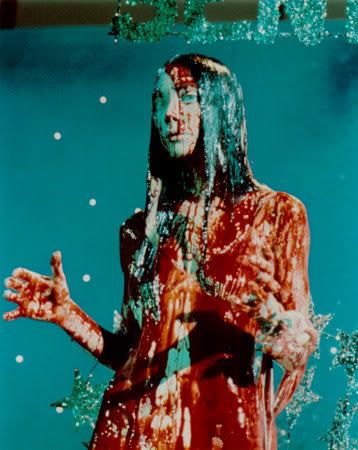
In part because of a current writing project, and in part because of recent thoughts/discussions about the gurlesque and the grotesque, my recent game is this: if everyone in my family were characters from a horror film, novel, or short story, who would they be? I'm not going to tell you my thoughts just yet (or maybe ever, unless I finish the project and someone publishes it). But the question lead me to think about female characters in horror, and then female perpetrators of violence in horror, and then to dynamics where the violence is specifically or mostly female-female OR where the major dynamic in the film is a relationship between two women.
The two that immediately came to mind were Alien 1 (Ripley vs. the female alien monster) and Suspiria (female protagonist discovers that her ballet school is really a cover for a coven of witches). Below is a list of others that immediately came to mind. Tell me what I'm missing--and yes, I know that this list is full of mostly films in English from the Western part of the world, but I suspect if I started looking at some of the recent anime other's have pointed me towards, I'd find more:
- Carrie (girl with telekinetic powers is abused by crazy Christian mother, eventually destroys her school, is stabbed in the back by her mother, but then telekinetically crucifies her mother with kitchen tools)
- Succubus (duh)
- Sheridan Le Fanu's Carmilla (female vampire!)
- Rosmary's Baby (Not so female-female violence, but it is a pregnancy horror)
- It's Alive (Also about the horror of babies)
- Friday the 13th (it's actually Jason's mom who is the killer, not Jason)
- The Ring
- Psycho (maybe only half makes the list, because the mom is dead, but she still exists as a taxidermied version of herself and in her son's head)
- "Ligeia," by Edgar Allan Poe (also only half on the list--a woman inhabits another woman's body, but it's a male fantasy)
- The Brain that Wouldn't Die
- Lair of the White Worm (mostly female-male violence, but some female-female violence)
- Dagon AD (The fish girl--although it's mostly about her trying to convince her brother that he should mate with her so they can live under the sea together forever)
- Dracula's vampire women should get a mention, even though they are clearly subordinate to him.
- The Exorcist (Definite mother-daughter thing)
Wednesday, May 14, 2008
Laura Glenum's Hounds of No

We're in the midst of a slight heat wave here on the coast. The guy I buy bread from at the farmer's market told me he thinks the strange weather is a sign of the End of Days, and also of global warming. "It's never colder in Escondido than it is in Carlsbad," he said. I told him that when the oil runs out and the apocalypse comes, I'll be in good shape with my bicycle. He laughed and said that I could ride up into the clouds and away from the horsemen.
So, in light of that discussion about the apocolypse, I thought I'd post my reading notes about Laura Glenum's The Hounds of No. Again, these are reading notes, not a full-fledged review. It will take several days to weed out the typos. I find that when I think "review" I'm unable to say anything useful. So, I write "notes" which later become "essays" or "reviews." So, on to the notes:
I've now actually read Laura Glenum's The Hounds of No (instead of just looking at it and reading every other poem and then skipping to the back to read the end). I really want to like this book. In theory, it's got everything I love:
macular holes, mucus, aliens, pigs, corpses, ovaries, aborted fetuses, sperm, aliens taking over bodies and exploding (again, with lots of mucus), bodies that explode (even without being surrogate alien parents), insects, S&M, parts of bodies (both human and non-human), doll houses, museums, dioramas, tableaux, Victorian wigs...
And more.
This book resonates with all the Modernist literature most dear to me: Mina Loy's "Pig cupid rooting his rosy snout in erotic garbage," for example, or practically every love affair in Djuna Barnes Nightwood. Maybe even H.D's Nights for it's masochistic and symbolic order that finally doesn't lead anywhere definite--"Two straight lines run into infinity." There's even a bit of Breton's Nadja here, although she shows up as something like an exploded mannequin, and the trail left by her plastic body parts doesn't lead any where sacred (even in a profane way).
I like the camp in this book, I appreciate the very obvious critique of female objectification, I like the fact that Glenum seems to care about what both Freud and Lacan have to say about the world (I think this is the first book I've read that quotes from Dora) and is able to critique them without shunning them completely.
In short, this book has many of the concerns of the Feminist avant-garde Modernists I mentioned above, and also New Narrative (There's a lot to unpack in that statement.)
And yet I'm not howling with ecstasy. Which puzzles me. Hounds of No is working with concerns with which I am, um, deeply concerned, but it also feels very familiar. Point #6 of Glenum's "Manifesto of the Anti-Real," is this:
"To be Anti-Real is not to be Surreal. The achievement of Surrealism lies in displacing correspondences, in the poem not arriving. In the Anti-Real, all assumptions are disabled, too, with one difference: the Anti-Real displaces causal logic with a totalizing logic of violence."
Sound's good. But Surrealism is interested in violence, too. Comte de Lautréamont's Les Chants de Maldoror is all about violence (and evil, and grotesque bodies, and how when you push these things far enough they become strangely beautiful and, dare I say, sacred), n'est pas? Although I guess he was really pre-Surrealist; they claimed him posthumously, right? I suppose pushing profanity until it becomes holy is a kind of arrival. And the heroine in H.D's Night does arrive at the bottom of a frozen lake, but the text doesn't have anything grand to say about it, except for the fact that the suicide is annoying and puzzling for everyone else still alive, so the text opens up again without arrival.
Surrealism isn't Feminist, of course. In many Surrealist poems, women are sacred entry points to the divine (often very literally) or guides to the mysteries of the universe. They show up naked in the woods at night, or they are lovers like Nadja who embody all that is mysterious, dark, violent (and, you guessed it, sacred) about the night cityscape. A cunt is great as long as it's imaginary. It's been a while since I looked, ahem, at Louis Aragon’s Le Con D’Irene, but still.
Ok. So I like The Hounds of No, but it's finally a little too neat for me to love it. The poems know their contexts--the grotesque, Christianity (which I haven't discussed), Surrealism and psychoanalysis and Feminist critiques of both, nods to critiques of post 9/11 politics--but I'm not sure the language went far enough for me. Let me try to be specific. The moves are really good, but they felt familiar. I keep thinking about Kathy Acker's Kathy Goes to Haiti :
"Is he your husband."
"No. I don't have a husband."
"Listen, you don't understand how things are in Haiti. Women in Haiti don't go around alone."
"What about the women who aren't married. Are there any women who aren't married?"
"They live with their families."
"It's not like that in the United States."
"You can't go to Jacmel alone. You have to have a boyfriend."
"But I don't want a boyfriend. I want to be alone."
"If you don't have a boyfriend, the driver of the Jeep'll become your boyfriend."
"You mean he'll rape me?"
"No. No. There is no violence in Haiti. Anybody can do anything they want in Haiti."
There's nothing formally crazy about that passage, and it's not fair to compare poetry to fiction, maybe, but that passage is super creepy and funny and it plays will all kinds of familiar problematic racial and gender stereotypes and fantasies. The last line makes me laugh and leap out of my skin. I'm not leaping out of my skin with Hounds of No. Maybe because its form creates distance between the reader and the text, and it does so on purpose. And "distance" isn't a code word for saying "it is experimental and uses enjambment and disjunction etc," although it does all of those things and I like all of those things. It's probably more of a code word for "performance," something else I like, especially when thinking about gender.
That doesn't quite describe what I mean when I say that Hounds of No is a bit familiar and that the language was good but didn't go far enough. But I'll have to stop here. I need to eat an early dinner so that I'm not sluggish during yoga this evening.
Maybe part of the problem is that I wasn't raised as a Christian--I've never even been baptized. I enjoyed the performance in Hounds of No, but I think I'd like to feel more threatened by it.
Sunday, May 04, 2008
My Life as Gilgamesh

I’m continuing to think about binaries, specifically gender binaries, and, yes, still in the context of Alma, although this post is going to noodle quite a bit. Basically, I grew up with some of the gender binaries that were important to certain kinds of 70s feminism—the kind of pop Feminism that celebrates and emphasizes woman’s connection to the earth, aboriginal peoples, and children. (Ah, even writing that sentence makes me want to leap out of my skin!) So, despite the many non-normative aspects of my childhood, no one was really overturning gender binaries. There was a lot of earth mother love though.
I received a pretty steady diet of hippie aesthetics and values as well as Western mythology growing up. Most of my friends came from global nomadic families, like mine, or else they were hippies (some wealthy, some genuinely not) who moved to Maine to establish communes and farm with various levels of success and failure. I lost touch with one particular high school friend after he graduated because he went to live in a teepee somewhere and was impossible to locate. Lao, if you’re reading this, drop me a line if you’re so inclined!
I moved around a lot as a child, but for several years I went to a Waldorf-inspired school in Blue Hill, Maine called the Bay School. Although the school now has an amazingly beautiful campus, when I went there, most of the classrooms were in a converted barn. We began everyday by lighting a candle and singing, reciting poetry, or playing musical instruments in what we called “opening circle.” I studied all of Mesopotamian, Greek, and Roman mythology. The only science I remember was the history of science—the Copernican revolution, Pythagoras, and stuff like that. I learned how to knit, and crochet, and how to weave on a loom. Although they didn’t do this at the time when I was there, during the third week of May every year, the fifth grade participates in a Greek Pentathlon with other Maine Waldorf schools “as a celebration of the harmonious nature of that age.”
It’s really too bad I didn’t study Sappho when I was learning to weave (that was in high school), because then I could have sung “O sweet mother, I cannot work the loom,” while working. Except that I probably wouldn’t have felt the perverse delight about it that I certainly would now.
It’s because of the Bay School, in part, that I can enjoy reading the section in Isadora Duncan’s My Life where she describes going to Greece in order to build a Greek temple. In retrospect, that section of the book is hilarious—she performs dances among the ruins and wears togas, all while being laughed at and at times cheated by the nearby villagers.
In yoga the other day, my teacher told us to imagine ourselves as maypoles—calm and steady while people were dancing all around you. Except that I actually do know how to dance around a maypole to create different weaving patterns. And a maypole is a big phallic symbol. So the whole class I kept on thinking that I didn’t want to imagine myself as a phallic symbol, and I don’t want to imagine myself as the happy child in floral dancing barefoot around the phallic symbol. Instead, I imagined the dead cat I’d seen on the road that morning.

And only a few days ago, I drew a picture of a maypole on the white board in my ESL classroom with little smiling stick figures holding attached ribbons, and tried to explain about dancing around a Maypole. My class of mostly Korean and Japanese 20-somethings looked at me, blankly. Finally, one young woman said. “That is strange.” And I said, “Most Americans do not know how to dance around a Maypole. Yes, it is strange.” Then I taught a lesson on conditionals (my favorite grammar!) The largest events at the Bay School were seasonal festivals. Apple fest in the fall, Nowell in winter, and May Day in the spring.
I like to make fun of the Bay School, but I’m so glad I went to school there and not in the suburbs. So very very very very glad. My education was better, and I was spared some of the hidden physical and emotional violence that comes with living in the suburbs. My teachers were amazingly intelligent and creative (and that bio doesn’t mention all the years Charles Hutchison, my 5th grade teacher, spent with Greenpeace); and many of them had very non-normative ideas about what success meant. My 6th grade teacher, for example, spent ten years of her life living in Hawaii, working as a waitress and surfing. I was a pretty uptight young kid, so I despised her and thought she was stupid while she was my teacher—what driving, intelligent person would want to hang out in Hawaii and surf? Now, of course I’m grateful that my adult role models weren’t all suggesting that I needed to grow up and become a doctor or a lawyer.
It wasn’t exactly a feminist curriculum, though, and why would it have been, I suppose, given the context. Given all the earth mother rhetoric, I’m surprised that I never developed the strong desire to have children—I’ve got the farm fantasy down, but not the baby fantasy. Still, I absorbed fairly classical masculine/feminine binaries. At the same time, though, I was allowed to play with being one or the other.

There were never any female heroines in any of the school plays, but I did get to enact the role of Gilgamesh in our end of the year 5th grade play. As Gilgamesh, I got to spurn the love of my best friend, J--, who was Ishtar. There’s a lot of gender tension and weirdness in that moment to unpack: I played the hero of a story that describes conquering the savage or feminine wilderness. I tame Enkidu, the beast in the desert, then love and spurn Ishtar, the goddess of fertility. After loosing my chance for immortality, I return home and build a walled city and write my story on the walls. How classically masculine is that?
Friday, May 02, 2008
No no no. No!
The third section of Alma is called "Guardian of the Earth." Still, this moment from the poem "Crudites of Enlightenment":
"thousand-armed. the one female version, a not-quite-deity, is always a principle of mercy. the mother fuckin' mother. are we merciful?" (140)
and this
"i live in negative space with all the dead women, whose potential erased while they lived i seek to restore, via the vengeance of language and the spreading of a message of pure negativity. the unveiling of light in our owl-like faces at midnight. i am enlightened and we are, i can say anything i want to. i am saved and we are, because i say so not to you. do you know that if my poetry lasts--that is if there is a future that is similar in any way to this present--my condemnation of our leaders will have considerable weight, and i am loading it down, the words that count will be mine. and our present leaders will be despised and laughed at. because this is the way literature works. though they are all too unread to know this" (141).
Before yoga class yesterday I was laying on the floor of the studio, trying to stretch my quadriceps, the other five women in the room began to have a conversation about children, and then pregnancy, and then giving birth, and then the cost of education but also how "children are a gift that lasts forever."
I like children as much as I like other humans. So that means I like some of them and don't like some of them. I respect their right to exist, like I respect everyone's right to exist, but I'm not going to be friends with everyone.
I think the pregnancy/children conversation at the yoga center is the default conversation the women have when they don't have anything to say to each other. Just like people who happen to move in shared contexts but don't actually have much in common talk about movies or how much they hate George Bush.
We usually say "I was born on June 11" not "my mother bore me on June 11." Blake says "My mother bore me..." in "Little Black Boy" and Jeremiah says "Cursed be the day on which I was born! The day when my mother bore me, let it not be blessed."
If you are the mother, you could say "I bore the child on June 11," or "I gave birth to the child on June 11." "I had the child on June 11" is common, but vague.
Another default conversation yoga conversation, or even greeting, is the "be positive and relax" conversation, often with the subtle but rather snobby suggestion that one person is actually more happy and relaxed than the other person.
One of my high school friends, who was very nice and positive, failed many of his classes during is first year at a University. I remember him saying, cheerfully "Oh well, I know I can do better next time," and I remember thinking, "dude, no you can't. You need to deal with the fact that you failed most of the beginning-level classes in your major."
Also, all during yoga, I kept on thinking about a dead cat I'd seen on the road that morning. In pincha mayurasana: dead cat, in urdhva dhanurasana: dead cat, in ardha chandrasana: dead cat, in ardha chandra chapasana: dead cat. Finally I said hello to the cat (not out loud, of course), and imagined breathing in all the elements of the cat that were now on the road by the lagoon, and in the air around it.
"thousand-armed. the one female version, a not-quite-deity, is always a principle of mercy. the mother fuckin' mother. are we merciful?" (140)
and this
"i live in negative space with all the dead women, whose potential erased while they lived i seek to restore, via the vengeance of language and the spreading of a message of pure negativity. the unveiling of light in our owl-like faces at midnight. i am enlightened and we are, i can say anything i want to. i am saved and we are, because i say so not to you. do you know that if my poetry lasts--that is if there is a future that is similar in any way to this present--my condemnation of our leaders will have considerable weight, and i am loading it down, the words that count will be mine. and our present leaders will be despised and laughed at. because this is the way literature works. though they are all too unread to know this" (141).
Before yoga class yesterday I was laying on the floor of the studio, trying to stretch my quadriceps, the other five women in the room began to have a conversation about children, and then pregnancy, and then giving birth, and then the cost of education but also how "children are a gift that lasts forever."
I like children as much as I like other humans. So that means I like some of them and don't like some of them. I respect their right to exist, like I respect everyone's right to exist, but I'm not going to be friends with everyone.
I think the pregnancy/children conversation at the yoga center is the default conversation the women have when they don't have anything to say to each other. Just like people who happen to move in shared contexts but don't actually have much in common talk about movies or how much they hate George Bush.
We usually say "I was born on June 11" not "my mother bore me on June 11." Blake says "My mother bore me..." in "Little Black Boy" and Jeremiah says "Cursed be the day on which I was born! The day when my mother bore me, let it not be blessed."
If you are the mother, you could say "I bore the child on June 11," or "I gave birth to the child on June 11." "I had the child on June 11" is common, but vague.
Another default conversation yoga conversation, or even greeting, is the "be positive and relax" conversation, often with the subtle but rather snobby suggestion that one person is actually more happy and relaxed than the other person.
One of my high school friends, who was very nice and positive, failed many of his classes during is first year at a University. I remember him saying, cheerfully "Oh well, I know I can do better next time," and I remember thinking, "dude, no you can't. You need to deal with the fact that you failed most of the beginning-level classes in your major."
Also, all during yoga, I kept on thinking about a dead cat I'd seen on the road that morning. In pincha mayurasana: dead cat, in urdhva dhanurasana: dead cat, in ardha chandrasana: dead cat, in ardha chandra chapasana: dead cat. Finally I said hello to the cat (not out loud, of course), and imagined breathing in all the elements of the cat that were now on the road by the lagoon, and in the air around it.
Monday, April 28, 2008
I continue to read Alma.
One step-up from my reading notes, and really a process of thinking.
The writing in Alma is expansive and messy. On the level of the book, I like it, on the level of the sentence or line, it's hit and miss for me. That's a vague thing to say, so I'll try to clarify. The expansive messiness is energetic--it's not the kind of beautiful lush s l u g g i s h prose that weighs down some experimental fiction--the energy of the language does carry me through each section. The punctuation in this is often interruptive and substantial--a lot of commas (pauses, breaths, interruptions) in places that don't always make traditional structural sense. Periods used like commas. Not a lot of question marks, though there are a few--this isn't an especially questioning book. Alma makes declarations and proclamations: here's a brief section from "State of the Union" that I hope will illustrate the kind of interrupted energetic language I'm trying to describe:
"and when she. so the novel. glistens in all its propriety. and then he. no it was
where i spied no on knows any doves. and the cool features of one one blue as
the sky, which i've been studying. you are, were you, that time. i don't have it's
in my body. hemmed in by if the all-powerful, but they're cliche-inscribed..."
The values this book ascribes to men and women continue to irk me, even when I keep in mind that the book is supposed to be a relentless rant / curse, and that it's written, at least in part, to irk. Here's a section from "Curse Tablet of Dead Women" that made me write "mmm" in the margin:
"...we demand the binding of the tongues and
limbs of any who would usurp our power in present or future, as male presidents,
leaders, officials elected or appointed or self-appointed, directors of institutions,
all men of wealth, and also men of no apparent stature, who would steal our
power. may your tongues and limbs be bound indefinitely" (125).
Then in my notes I wrote: it's kind of interesting to speak in the language of the oppressor, or to reverse a binary, but it's still a binary, and power is power.
Women who support patriarchy are also cursed later in the poem:
"...as for those
who would want to justify our lives in their own sentimentality: that we must
have been happy and found our own fulfillment: may you be bound from speak-
ing so, male or female..."(125).
I'm excited about any moment in feminist writing that thinks about how certain kinds of feminine behavior might support traditional patriarchal hierarchies instead of undermining or resiting them (one of the things I obsess about in my own writing). I like the fact that Alma is aggressive--it's not passive aggressive or subtle about it's accusations. Of course, that's also it's weakness.
(Aside: I feel pressured to write poems and criticism that are open-ended and questioning. Lyn Hejinian is right--closure and conclusion certainly do have their problems. I like Leslie Scalapino's question marks. But I admit that I like things to be definite, too. I want to say "you are a total asshole," and not question it. I also want to say, "I will organize the party" or "I am happy to curate the reading series." I hate it when people stand around talking about how no one will do anything, and then hating the people who do something. This happens a lot in any community where everyone is supposed to be equal in some usually undefined way but really isn't. That's my own Alma-rant of the day).
Alma in Alma is almost perfectly feminine in the postmodern sense: she's total negation and non-symbolic otherness--she enters the world through archetypal symbols or marks imposed on her by men. On the other hand, the voices in Alma are also agressive in a way that, yes, is violent and masculine. The curse I quoted from above expresses a desire for a world where women rule and men are bound and punished--it's not a critique of power, it's a critique of the fact that men have all of it.
So, the voices in Alma remind me of Rachel Blau DuPlessis' description of the numerous kinds of feminine subjectivity at work in Anne Waldman's work, and how Michael Davidson describes Sylvia Plath in Guys Like Us. Here's a quote from DuPlessis' "Anne Waldman: Standing Corporeally in One's Time," (from Jacket Magazine #27) that also quotes Davidson:
"Waldman is certainly one of the exemplars of female masculinity. Indeed, Waldman might be closest in her ferocity, performativity, and aggressions to the picture Michael Davidson draws of Sylvia Plath in Guys Like Us, with those “self-conscious assaults on gender binarism” (Davidson 160) by someone who will “interrogate masculine aspirations from within a speaker who embodies many of those aspirations” (Davidson 170)."
In terms of content, Alma doesn't really attempt an assault on gender binarism. Like Descent of Allette, it holds on to gender binaries and doesn't let go. However, structurally, Alma does mess with gender binaries--it's lyric and epic, it's declarative and aggressive but full of disruptions (in grammar, sentence-structure, and punctuation, for example), it moves from reportage to song and back...Form and content (or content and form, if you prefer), always exist in tension with each other (whether we want them to or not). I like poems that make this tension interesting (Kristeva's notion of the "ethical text," maybe I'll elaborate later).
Alma does have an interesting form/content dynamic, especially when I consider the ways in which that dynamic both supports and undermines gender binaries.
The writing in Alma is expansive and messy. On the level of the book, I like it, on the level of the sentence or line, it's hit and miss for me. That's a vague thing to say, so I'll try to clarify. The expansive messiness is energetic--it's not the kind of beautiful lush s l u g g i s h prose that weighs down some experimental fiction--the energy of the language does carry me through each section. The punctuation in this is often interruptive and substantial--a lot of commas (pauses, breaths, interruptions) in places that don't always make traditional structural sense. Periods used like commas. Not a lot of question marks, though there are a few--this isn't an especially questioning book. Alma makes declarations and proclamations: here's a brief section from "State of the Union" that I hope will illustrate the kind of interrupted energetic language I'm trying to describe:
"and when she. so the novel. glistens in all its propriety. and then he. no it was
where i spied no on knows any doves. and the cool features of one one blue as
the sky, which i've been studying. you are, were you, that time. i don't have it's
in my body. hemmed in by if the all-powerful, but they're cliche-inscribed..."
The values this book ascribes to men and women continue to irk me, even when I keep in mind that the book is supposed to be a relentless rant / curse, and that it's written, at least in part, to irk. Here's a section from "Curse Tablet of Dead Women" that made me write "mmm" in the margin:
"...we demand the binding of the tongues and
limbs of any who would usurp our power in present or future, as male presidents,
leaders, officials elected or appointed or self-appointed, directors of institutions,
all men of wealth, and also men of no apparent stature, who would steal our
power. may your tongues and limbs be bound indefinitely" (125).
Then in my notes I wrote: it's kind of interesting to speak in the language of the oppressor, or to reverse a binary, but it's still a binary, and power is power.
Women who support patriarchy are also cursed later in the poem:
"...as for those
who would want to justify our lives in their own sentimentality: that we must
have been happy and found our own fulfillment: may you be bound from speak-
ing so, male or female..."(125).
I'm excited about any moment in feminist writing that thinks about how certain kinds of feminine behavior might support traditional patriarchal hierarchies instead of undermining or resiting them (one of the things I obsess about in my own writing). I like the fact that Alma is aggressive--it's not passive aggressive or subtle about it's accusations. Of course, that's also it's weakness.
(Aside: I feel pressured to write poems and criticism that are open-ended and questioning. Lyn Hejinian is right--closure and conclusion certainly do have their problems. I like Leslie Scalapino's question marks. But I admit that I like things to be definite, too. I want to say "you are a total asshole," and not question it. I also want to say, "I will organize the party" or "I am happy to curate the reading series." I hate it when people stand around talking about how no one will do anything, and then hating the people who do something. This happens a lot in any community where everyone is supposed to be equal in some usually undefined way but really isn't. That's my own Alma-rant of the day).
Alma in Alma is almost perfectly feminine in the postmodern sense: she's total negation and non-symbolic otherness--she enters the world through archetypal symbols or marks imposed on her by men. On the other hand, the voices in Alma are also agressive in a way that, yes, is violent and masculine. The curse I quoted from above expresses a desire for a world where women rule and men are bound and punished--it's not a critique of power, it's a critique of the fact that men have all of it.
So, the voices in Alma remind me of Rachel Blau DuPlessis' description of the numerous kinds of feminine subjectivity at work in Anne Waldman's work, and how Michael Davidson describes Sylvia Plath in Guys Like Us. Here's a quote from DuPlessis' "Anne Waldman: Standing Corporeally in One's Time," (from Jacket Magazine #27) that also quotes Davidson:
"Waldman is certainly one of the exemplars of female masculinity. Indeed, Waldman might be closest in her ferocity, performativity, and aggressions to the picture Michael Davidson draws of Sylvia Plath in Guys Like Us, with those “self-conscious assaults on gender binarism” (Davidson 160) by someone who will “interrogate masculine aspirations from within a speaker who embodies many of those aspirations” (Davidson 170)."
In terms of content, Alma doesn't really attempt an assault on gender binarism. Like Descent of Allette, it holds on to gender binaries and doesn't let go. However, structurally, Alma does mess with gender binaries--it's lyric and epic, it's declarative and aggressive but full of disruptions (in grammar, sentence-structure, and punctuation, for example), it moves from reportage to song and back...Form and content (or content and form, if you prefer), always exist in tension with each other (whether we want them to or not). I like poems that make this tension interesting (Kristeva's notion of the "ethical text," maybe I'll elaborate later).
Alma does have an interesting form/content dynamic, especially when I consider the ways in which that dynamic both supports and undermines gender binaries.
Sunday, April 20, 2008
Hags rant about things you wish they wouldn't rant about.

Rereading, with more attention (and interest) Alice Notley's Alma, or The Dead Women. I'm not going to write a review, since I'm not finished with the book, but I think it will help if I blog my thoughts as I'm reading and thinking.
This is an angry book. I like it that Alma is angry. She's not a heroine like Allette. Alma's a hag, not a warrior. She's a bit like the Cailleach or Morrígna--she's a god but no one really treats her like one. Alma shoots up into her forehead and dreams/hallucinates the world. It reminds me of how the fire and light from Shiva's third eye can annihilate evil--but also how he often opens up his third eye when he's angry, to burn things (like Brahma's 5th head that liked to badmouth him).
So, Notley continues to work with big archetypal female characters. I can't think of any other epics where the central figure is an angry, often self-righteous hag. It's true, hags are dangerous, erratic (Baba Yaga sometimes helps you, sometimes tries to eat you, and she lives in a house built on dancing chicken legs, so the house moves and looks really creepy), and often annoying. I often find the character Alma to be all of these things--but it's hardly an accident. In "The Invisible Organ Presence," Notley writes:
"That a woman is a composition? a trial lawyer, a severity, a bother to one who would move up, an aging hypnotist an aging theoretician, always the nag, the complainer, the denouncer, the radical feminist. nothing you can say, it doesn't matter what i say, it's always heard in the image of the ear of another, this has been said before, everything you do is meaningless..." (42).

Alma, or The Dead Women imagines the hag as a powerful alternative to being any of these things.
The female/male binary in this book is pretty absolute. Men kill and make war, women don't. This dynamic comes up over and over again in the book, and it irks me. But then there are moments where this dynamic is undermined. So maybe the book doesn't hold firm to that dynamic. I don't know. Here's a section from "The Stupid Guy Etc" that I think is quite funny, although I don't really associate camp or humor with Notley's work, so maybe it's just me:
"because this guy is stupid, you find out by fucking them don't you, and who is there but the stupid to fuck at this point. the moment is the one just past when the seeds have spread throughout the world that moment when we were still just fucking almost fearlessly" (33).
(Note to self: that section also makes me think of San Diego county, bad decisions about marriage, and fantasies about domestic life that still exist even when they don't work).
or this one from "Of Luz, Cosette and of Vengeance":
"Do we want people to die? no, we want them to know they are guilty, and stupid. we want to abolish sexes themselves. races themselves. we want to abolish everything you stand for" (37).
The you in the first section, I think, implicates women readers, and the you in the second section refers to all the evil, nasty, war-loving men that show up throughout the book. Not all the men in the book love evil, though. Dick Cheney is there, but so is Sonny--who is mostly a stupid and naive young man who wants to go to war because he knows nothing about it, really. He's stupid and tragic.
This poem is mostly a poem about women in a world of violence, men, and war. But let me quote one more section, this one from the second half of the book, a section called "The Boys and Men":
"the boys and men who came with us just chose to come with. and no make no new social order, make no social order, they just chose to, to come with us. they too had nothing left, in or outside. this is a story of women but i want you to know"(205).
Not all the men are stupid and violent, but this book isn't about them.
Allette is angry, but she rises above her rage, or at least uses it for something productive. Alma is productive in any normative way, and she exists because of and through her rage and pain. I'm both attracted to and annoyed by mythic archetypes in poetry--but I see their value: a hag can really, really rant. And rant. The point is that a hag really rants a lot. Of course you want her to shut up.
Other stuff to think about:
- Nagging sense that Alma is just as pious and uptight about her world view as the men in the book. This really would be, I think, the major problem...
- Old Hag Syndrome (sleep, hallucinations...)
- The hag (in Persian mythology, maybe, who lays on your chest at night so you feel like you can't breath. Associated with Old Hag Syndrome).
- Hag's connection to battlefields (Morrígan in the Táin Bó Cuailnge)
- And sovereignty--land, etc. Hag is sometimes the barren land. Hero usually has to confront her.
Sunday, February 24, 2008
How is it possible that tomorrow is Monday? I had a three day teaching week last week, so now I feel like every week should be a three-day week.
A yogurt went bad. We had to throw it out. Quel dommage.
Mark and I watched an episode called "The Lost Child" from the 4th season of Prime Suspect on Friday night. It was tense. I remember my mom liking the Prime Suspect series. The episode felt very 90s pop Feminist. Detective Inspector Jane Tennison is woman in power, but the rest of the bureaucracy is all men, and she's often at odds with her superiors. The episode begins with the suggestion that she's had an abortion, and the plot revolves around the problems of motherhood and having a career. The murder victim is a toddler and the murderer turns out to be the mother (who was crazy, tired, studying for law exams, and frustrated with bourgeois pressures). Interestingly, there's a character who's a (former) pedophile--he's the main suspect, but completely innocent. In some ways he's a rather sympathetic character, even though he's also disgusting.
Anyway, the episode made me think about 90s Feminism, and Hilary Clinton, and the Democratic debate in Austin on Thursday. I drank almost too much and stayed up past midnight--both of which are pretty hard to do in San Diego north county. I want the primaries to be over.
A yogurt went bad. We had to throw it out. Quel dommage.
Mark and I watched an episode called "The Lost Child" from the 4th season of Prime Suspect on Friday night. It was tense. I remember my mom liking the Prime Suspect series. The episode felt very 90s pop Feminist. Detective Inspector Jane Tennison is woman in power, but the rest of the bureaucracy is all men, and she's often at odds with her superiors. The episode begins with the suggestion that she's had an abortion, and the plot revolves around the problems of motherhood and having a career. The murder victim is a toddler and the murderer turns out to be the mother (who was crazy, tired, studying for law exams, and frustrated with bourgeois pressures). Interestingly, there's a character who's a (former) pedophile--he's the main suspect, but completely innocent. In some ways he's a rather sympathetic character, even though he's also disgusting.
Anyway, the episode made me think about 90s Feminism, and Hilary Clinton, and the Democratic debate in Austin on Thursday. I drank almost too much and stayed up past midnight--both of which are pretty hard to do in San Diego north county. I want the primaries to be over.
Wednesday, October 31, 2007
More Numbers, Gender, Inertia
Happy Halloween. I am a sick person for Halloween, with more of a chest cough and less of a fever than yesterday. But I am sick. More sick than I've been in at least three years.
Conversation continues over at Rhubarb is Susan in various ways. Linda Russo posted a comment there that articulates much of what I agree is very useful about Juliana Spahr and Stephanie Young's research. I'm glad that this conversation is happening in multiple ways, and in multiple places.
It wasn't my intention to turn the conversation into a conversation about Pussipo, but here I am, mentioning us again. Ambivalent is my word of the week. I am ambivalent about women's only spaces. What that means is I think that they are valuable...I wish that everyone could feel a certain basic level of comfort and ease everywhere, but they don't. And can't.
I nearly went to Barnard, but decided not to after attending an orientation session for accepted freshmen. I grew up around boys, and had only one good female friend in high school (who went to Bryn Mawyr and loved it). I realized I didn't want to be in a women-only environment and, moreover, I wasn't comfortable in one. I don't think it's an accident that as an undergraduate I studied political science, a field that is really perfect for having macho showdowns of wit and knowledge. If done well, I enjoy macho showdowns of wit and knowledge, both as participant and observer.
I'm more comfortable in women-centered environments, now, but it's a learning process. Pussipo is a network and a resource I turn to for conversation and input about all sorts of things. Mark & I live in Carlsbad, CA--no one is coming over on a Wednesday night to hang out and talk poetry, or anything else. The people on that list are my peers--not my only peers, but a substantial percentage of them. Conversation is good.
Conversation continues over at Rhubarb is Susan in various ways. Linda Russo posted a comment there that articulates much of what I agree is very useful about Juliana Spahr and Stephanie Young's research. I'm glad that this conversation is happening in multiple ways, and in multiple places.
It wasn't my intention to turn the conversation into a conversation about Pussipo, but here I am, mentioning us again. Ambivalent is my word of the week. I am ambivalent about women's only spaces. What that means is I think that they are valuable...I wish that everyone could feel a certain basic level of comfort and ease everywhere, but they don't. And can't.
I nearly went to Barnard, but decided not to after attending an orientation session for accepted freshmen. I grew up around boys, and had only one good female friend in high school (who went to Bryn Mawyr and loved it). I realized I didn't want to be in a women-only environment and, moreover, I wasn't comfortable in one. I don't think it's an accident that as an undergraduate I studied political science, a field that is really perfect for having macho showdowns of wit and knowledge. If done well, I enjoy macho showdowns of wit and knowledge, both as participant and observer.
I'm more comfortable in women-centered environments, now, but it's a learning process. Pussipo is a network and a resource I turn to for conversation and input about all sorts of things. Mark & I live in Carlsbad, CA--no one is coming over on a Wednesday night to hang out and talk poetry, or anything else. The people on that list are my peers--not my only peers, but a substantial percentage of them. Conversation is good.
Monday, October 29, 2007
Numbers, Gender, Inertia
I do not want to grade my online class, but I am. I did not want to tutor for two hours at Smarthinking this morning, but I did. I did not want to clean out the top tray of my desk inbox--the one with actual paper in it, but I did.
Reading, with ambivalence, Simon DeDeo's response to the essay by Juliana Spahr and Stephanie Young, "Numbers Trouble," in the Chicago Review 53:2/3. This essay is a version of a presentation that they gave at Feminaissance back at the end of April. I've not read the essay, but I was there at the talk and took notes. I remember thinking, "I am glad that someone counted, because now we don't have to argue about the numbers." Of course, we have to argue about what they might mean. That's a conversation worth having, but I'm not going to blog about it now, especially since I don't have the article in front of me.
Simon's comments about pussipo are similar to those expressed by some very dear friends who are men.
And I agree, without having any statistics, that men tend to submit their poems more than women, and tend to respond to queries for work more quickly and promptly. I certainly have been guilty of taking my sweet time to respond to enthusiastic editors. Why? It probably does have something to do with feelings I have about being assertive and public, and I'm sure those have something to do with how I was raised, and I'm sure that all has something to do with gender, too.
But I'm getting better! I have now responded to all outstanding requests for work or invitations to submit work with the exception of Absent. Yikes! But I have your deadline on my mind and on my calendar, and I think I know what to send.
This part of Simon's post also interested me:
"It is just as vital to assert that these images are very particular. While the number of male modes (for whites -- compare the treatment of Amiri Baraka to Fredrick Seidel) is broad to the point of freedom, it is, in my experience that women do not have this freedom. "
I've often felt the exact opposite--but, again, I don't have any evidence to back this up. It's a bit of a theoretical cliche for me to assert that as a woman my subjectivity is more, um, shifty than that of a man (woman as riot, etc). I've found that as more or less straight young woman, it's been ridiculously easy to get endless entry-level jobs in a variety of professions. It was relatively easy to shift my academic focus from modern Chinese history to English literature, and it was relatively easy to make a professional shift again out of the DC public policy world to teaching ESL and doing freelance graphic design. My CV is confusing. I have 6 different resumes that I use depending on the project I'm bidding on.
My life as a poet has been similar--I make "post-language" poems, procedural translations, procedural poems, things that kind of resemble new narrative, prose poems that kind of resemble, um, some combination of langpo and new narrative, visual poems, collages, sound poems, sound collages, short stories with narrative in the more traditional sense of the word... Now I'm working on a piece that involves choreography. Yay!
That's all very exciting, but it's a bit disturbing, too. I feel like one reason why I've had so much flexibility is because I'm perceived as so very unthreatening. I'm 29, pretty and nerdy. I am even happy and enthusiastic. I am unavailable! I like to party! I don't think anyone really gives a crap about what I say or do. That's a kind of freedom, I suppose. I'm overstating my point for effect, but some of what I've said must be true.
Potential Employer: "Are you on your husband's health insurance?"
Me: "I am not married."
Reading, with ambivalence, Simon DeDeo's response to the essay by Juliana Spahr and Stephanie Young, "Numbers Trouble," in the Chicago Review 53:2/3. This essay is a version of a presentation that they gave at Feminaissance back at the end of April. I've not read the essay, but I was there at the talk and took notes. I remember thinking, "I am glad that someone counted, because now we don't have to argue about the numbers." Of course, we have to argue about what they might mean. That's a conversation worth having, but I'm not going to blog about it now, especially since I don't have the article in front of me.
Simon's comments about pussipo are similar to those expressed by some very dear friends who are men.
And I agree, without having any statistics, that men tend to submit their poems more than women, and tend to respond to queries for work more quickly and promptly. I certainly have been guilty of taking my sweet time to respond to enthusiastic editors. Why? It probably does have something to do with feelings I have about being assertive and public, and I'm sure those have something to do with how I was raised, and I'm sure that all has something to do with gender, too.
But I'm getting better! I have now responded to all outstanding requests for work or invitations to submit work with the exception of Absent. Yikes! But I have your deadline on my mind and on my calendar, and I think I know what to send.
This part of Simon's post also interested me:
"It is just as vital to assert that these images are very particular. While the number of male modes (for whites -- compare the treatment of Amiri Baraka to Fredrick Seidel) is broad to the point of freedom, it is, in my experience that women do not have this freedom. "
I've often felt the exact opposite--but, again, I don't have any evidence to back this up. It's a bit of a theoretical cliche for me to assert that as a woman my subjectivity is more, um, shifty than that of a man (woman as riot, etc). I've found that as more or less straight young woman, it's been ridiculously easy to get endless entry-level jobs in a variety of professions. It was relatively easy to shift my academic focus from modern Chinese history to English literature, and it was relatively easy to make a professional shift again out of the DC public policy world to teaching ESL and doing freelance graphic design. My CV is confusing. I have 6 different resumes that I use depending on the project I'm bidding on.
My life as a poet has been similar--I make "post-language" poems, procedural translations, procedural poems, things that kind of resemble new narrative, prose poems that kind of resemble, um, some combination of langpo and new narrative, visual poems, collages, sound poems, sound collages, short stories with narrative in the more traditional sense of the word... Now I'm working on a piece that involves choreography. Yay!
That's all very exciting, but it's a bit disturbing, too. I feel like one reason why I've had so much flexibility is because I'm perceived as so very unthreatening. I'm 29, pretty and nerdy. I am even happy and enthusiastic. I am unavailable! I like to party! I don't think anyone really gives a crap about what I say or do. That's a kind of freedom, I suppose. I'm overstating my point for effect, but some of what I've said must be true.
Potential Employer: "Are you on your husband's health insurance?"
Me: "I am not married."
Friday, October 12, 2007
There were about 10 middle-aged women protesting outside of Planned Parenthood today
when I went to pick up my birth control after work. Birth control is a weird term. When I'm feeling hostile I refer to it as "anti-baby pills," but my birth control isn't pill-form and I don't use it because I'm anti-baby. I don't want to have children, ever, but I am not anti-child. Maybe I am anti-baby culture. The protesters had predictable anti-abortion signs and signs advocating abstinence.
I don't advocate abstinence, but I'm hardly pro-abortion. No one is pro-abortion. Everyone is in favor of life. Life is good (it's abstract, but life generally has a positive connotation). Pro-life is not the logical opposite of pro-choice.
I was at dinner with some poet friends once and someone said, bitterly, "women don't matter, only babies." I was 23 and living in an urban area that voted Democrat and Green and so I thought, "Wow, that is kind of uptight." However, I now understand that statement. San Diego papers frequently run articles implying that Feminism has gone too far.
Feminism hasn't even arrived in San Diego county yet.
When I left Planned Parenthood with a bag of birth control and a bike ride by the lagoon and the entire weekend ahead of me, I felt quite pleased with myself. I wasn't the one stuck in a strip mall parking lot on a lovely Friday afternoon with an anti-abortion sign.
I don't advocate abstinence, but I'm hardly pro-abortion. No one is pro-abortion. Everyone is in favor of life. Life is good (it's abstract, but life generally has a positive connotation). Pro-life is not the logical opposite of pro-choice.
I was at dinner with some poet friends once and someone said, bitterly, "women don't matter, only babies." I was 23 and living in an urban area that voted Democrat and Green and so I thought, "Wow, that is kind of uptight." However, I now understand that statement. San Diego papers frequently run articles implying that Feminism has gone too far.
Feminism hasn't even arrived in San Diego county yet.
When I left Planned Parenthood with a bag of birth control and a bike ride by the lagoon and the entire weekend ahead of me, I felt quite pleased with myself. I wasn't the one stuck in a strip mall parking lot on a lovely Friday afternoon with an anti-abortion sign.
Friday, June 15, 2007
I would like to have several layers of my skin removed and
other things, too.
I still have hives.
Today on break I was talking with two of my students, a Japanese woman and a young man from Italy.
Japanese woman: Most women here are sluts.
Italian man: Yeah, all the women I meet at bars are sluts.
Me: that is because you are going to slut bars.
Pause.
Me: The US is big, and there are many different kinds of people here, just like there are many different kinds of people in Europe.
I remember when I was going to a French school in Guangzhou, I started swearing frequently, because it's easy to swear in a foreign language, people think it's funny, and you don't really know what you're saying. I spent several months saying "bitch" and "shove it up your ass" until I realized what I was saying. Currently, my students like saying "bitch," "slut," and "hell."
We're a long way from a discussion about Feminism.
I still have hives.
Today on break I was talking with two of my students, a Japanese woman and a young man from Italy.
Japanese woman: Most women here are sluts.
Italian man: Yeah, all the women I meet at bars are sluts.
Me: that is because you are going to slut bars.
Pause.
Me: The US is big, and there are many different kinds of people here, just like there are many different kinds of people in Europe.
I remember when I was going to a French school in Guangzhou, I started swearing frequently, because it's easy to swear in a foreign language, people think it's funny, and you don't really know what you're saying. I spent several months saying "bitch" and "shove it up your ass" until I realized what I was saying. Currently, my students like saying "bitch," "slut," and "hell."
We're a long way from a discussion about Feminism.
Monday, March 19, 2007
So, the next time you see me, and it's clear that I'm wearing false eyelashes, think "ethical text."
Today someone came into the studio to buy yoga mats, looked around, and then asked us about the pictures of naked women she'd heard about. We do, in fact, have pictures of naked women in various asanas on the walls of our studio. Many. I found it interesting that the woman had heard of them, but did not notice them on the walls (there are seven in the boutique alone) until I pointed them out. She didn't mind them, she said, as long as they were tasteful and there were no nipples showing. But there are nipples in some of them. Nipples seem to bother people. Even the word. Nipple. Nipple. Nipple.
1. Female nudes are mainstream, if you want to cause a stir, display pictures of nude men.
2. I am glad that there are no pictures of nude men at the studio.
3. Female nudes are mainstream because both women and men are used to thinking of women as sexual objects. Duh.
4. Whether or not being a nude woman or looking at nude women is empowering depends on all sorts of things, like how one comes to be the nude woman or the person looking at the nude woman.
5. As I've written before, breasts, whether they are displayed ironicaly, for art, or to convey some kind of spiritual ideal (or some combination of all this an more), are still sexual. This isn't neccessarily bad, but let's be clear. Sex and objectification doesn't go away.
6. Etc.
When I first started taking classes here, I noted the pictures. Most are black and white, or in sepia, with moody drapes and lighting. All of the nudes are women (although the photographer does have some male nudes as well). They're very stylized and slick. They're supposed to be celebratory and, I suppose, inspiring. I either ignore them or find myself staring at the models' breasts. If I were a teenager I might feel uncomfortable around them. So, the woman who came in wanted me to pass a long a formal complaint about them to the directors. They're not pornographic, but they are female nudes. A lot of people comment on the pictures, but this is the first time anyone has complained about them.
This ties in with something Nada wrote about a few days ago (and for some reason, the computer I'm on won't let me post a link just now, so I'll have to do that later). So I'll quote:
"Is my extreme self-consciousness in fact a kind of “false consciousness” (a phrase I was reminded of reading a review of abook on poverty in the Times today, in which a woman rationalizes her extreme poverty and alcoholism by saying that she must have committed some grave sins in previous lives)? Am I deceiving myself that I am reclaiming roses and ruffles, and that because everything I do is steeped in performative irony I am not buying into received notions of womanhood? That my parade of images of myself is not in fact a true narcissism but rather a going-to-extremes of self-consciousness in order to work through it, as an aspiring Buddhist might lose himself in alcohol and promiscuity on the way to enlightenment? Aw, hell."
I wrote about this in the dialogue Jessica and I published in Traffic--I'm interested in heightening the substantial gray area between what is real and what is artifice. This isn't an especially new Feminist tactic or anything. It's pretty basic, but I think that we (Feminist experimental poets) need to keep talking about performance, artifice, and recieved notions of womenhood--so I was especially happy to read Nada's post for that reason.
Again and again I rely on my ability to play (BE) a sweet, sunshiney, (and sometimes Californian) blonde as a way of manipulating recieved notions of womanhood, and recieved notions of what a Feminist, politically aware experimental poet should look and act like. Although manipulating it to what end, I'm not sure. Maybe it's just as simple as Kristeva's idea of an ethical text. Which, to generalize and paraphrase in Lorraine language, is just a text that makes the reader aware of how it is constructed. An ethical text says, "look, someone made me. Here are my seams, here is my form."
1. Female nudes are mainstream, if you want to cause a stir, display pictures of nude men.
2. I am glad that there are no pictures of nude men at the studio.
3. Female nudes are mainstream because both women and men are used to thinking of women as sexual objects. Duh.
4. Whether or not being a nude woman or looking at nude women is empowering depends on all sorts of things, like how one comes to be the nude woman or the person looking at the nude woman.
5. As I've written before, breasts, whether they are displayed ironicaly, for art, or to convey some kind of spiritual ideal (or some combination of all this an more), are still sexual. This isn't neccessarily bad, but let's be clear. Sex and objectification doesn't go away.
6. Etc.
When I first started taking classes here, I noted the pictures. Most are black and white, or in sepia, with moody drapes and lighting. All of the nudes are women (although the photographer does have some male nudes as well). They're very stylized and slick. They're supposed to be celebratory and, I suppose, inspiring. I either ignore them or find myself staring at the models' breasts. If I were a teenager I might feel uncomfortable around them. So, the woman who came in wanted me to pass a long a formal complaint about them to the directors. They're not pornographic, but they are female nudes. A lot of people comment on the pictures, but this is the first time anyone has complained about them.
This ties in with something Nada wrote about a few days ago (and for some reason, the computer I'm on won't let me post a link just now, so I'll have to do that later). So I'll quote:
"Is my extreme self-consciousness in fact a kind of “false consciousness” (a phrase I was reminded of reading a review of abook on poverty in the Times today, in which a woman rationalizes her extreme poverty and alcoholism by saying that she must have committed some grave sins in previous lives)? Am I deceiving myself that I am reclaiming roses and ruffles, and that because everything I do is steeped in performative irony I am not buying into received notions of womanhood? That my parade of images of myself is not in fact a true narcissism but rather a going-to-extremes of self-consciousness in order to work through it, as an aspiring Buddhist might lose himself in alcohol and promiscuity on the way to enlightenment? Aw, hell."
I wrote about this in the dialogue Jessica and I published in Traffic--I'm interested in heightening the substantial gray area between what is real and what is artifice. This isn't an especially new Feminist tactic or anything. It's pretty basic, but I think that we (Feminist experimental poets) need to keep talking about performance, artifice, and recieved notions of womenhood--so I was especially happy to read Nada's post for that reason.
Again and again I rely on my ability to play (BE) a sweet, sunshiney, (and sometimes Californian) blonde as a way of manipulating recieved notions of womanhood, and recieved notions of what a Feminist, politically aware experimental poet should look and act like. Although manipulating it to what end, I'm not sure. Maybe it's just as simple as Kristeva's idea of an ethical text. Which, to generalize and paraphrase in Lorraine language, is just a text that makes the reader aware of how it is constructed. An ethical text says, "look, someone made me. Here are my seams, here is my form."
Saturday, March 17, 2007
Denunciation will make me powerful!
One of my students is headed back to Venezuela this weekend. She said if she ever starts her own company and becomes rich, she will be my patron.
Harlequin Knights reports that, at a recent UCLA lecture, Zizek castigated all the "experimental American poets" who are in love with Hugo Chavez. My student is not in love with Hugo Chavez and neither am I. Like Joseph, I wonder who he means. However, some of us must be prone to a romantic love of his rhetoric, that seems certain.
Here in the San Diego suburbs, having recently returned from a trip to Target, it's tempting to get all teary-eyed about Chavez addressing a crowd of protesters in his customary red shirt screaming "Gringo, go home!" or "Those who want to go directly to hell, they can follow capitalism" and "Those of us who want to build heaven here on earth, we will follow socialism."
This fire and brimstone rhetoric appeals to my Feminist WASP guilt complex. Yes, yes, I think, let the denunciations continue! Denounce me! I want to be denounced!
But I'm also tired, and have just had a big capitalist breakfast.
I work hard. And a lot. I want a big capitalist breakfast and also health care.
I wonder where a journal like Cross-Cultural Poetics might stand (or have stood) on loving Chavez or not. Has there been a recent issue of XCP?
In fact, what are the current magazines that feature a combination of poetry, critical pieces, reviews, and other stuff. I mean magazines in the tradition (if I can even say that) of XCP, Chain, Tripwire, Ecopoetics, Tinfish, Verdure, The Poker Magazine, Jacket, How2....
I have a copy of Pilot 2006 on my desk that I'm still going through. This might count. A fairly wide range of material. A fairly rigorous attempt at discussing poetics. Uneven but risky, so I like it.
Well. Given my list, it looks like that when I talk about magazines "that feature a combination of poetry, critical pieces, reviews, and other stuff" I often mean magazines connected to Buffalo. Or, magazines edited by people who are well versed in experimental poetics since 1920.
With the exception of Jacket and How2, I don't think any of the magazines above would make my favorites list. But Lorraine, what are your favorite contemporary magazines that are still active/in print? Um, um...
How2
Jacket
Foursquare
Tarpaulin Sky
Pilot
Big Bridge
Fiction International
Submodern Fiction (which, yes, Mark edits and I will soon co-edit and which is on hiatus but will have another issue by this fall)
Harlequin Knights reports that, at a recent UCLA lecture, Zizek castigated all the "experimental American poets" who are in love with Hugo Chavez. My student is not in love with Hugo Chavez and neither am I. Like Joseph, I wonder who he means. However, some of us must be prone to a romantic love of his rhetoric, that seems certain.
Here in the San Diego suburbs, having recently returned from a trip to Target, it's tempting to get all teary-eyed about Chavez addressing a crowd of protesters in his customary red shirt screaming "Gringo, go home!" or "Those who want to go directly to hell, they can follow capitalism" and "Those of us who want to build heaven here on earth, we will follow socialism."
This fire and brimstone rhetoric appeals to my Feminist WASP guilt complex. Yes, yes, I think, let the denunciations continue! Denounce me! I want to be denounced!
But I'm also tired, and have just had a big capitalist breakfast.
I work hard. And a lot. I want a big capitalist breakfast and also health care.
I wonder where a journal like Cross-Cultural Poetics might stand (or have stood) on loving Chavez or not. Has there been a recent issue of XCP?
In fact, what are the current magazines that feature a combination of poetry, critical pieces, reviews, and other stuff. I mean magazines in the tradition (if I can even say that) of XCP, Chain, Tripwire, Ecopoetics, Tinfish, Verdure, The Poker Magazine, Jacket, How2....
I have a copy of Pilot 2006 on my desk that I'm still going through. This might count. A fairly wide range of material. A fairly rigorous attempt at discussing poetics. Uneven but risky, so I like it.
Well. Given my list, it looks like that when I talk about magazines "that feature a combination of poetry, critical pieces, reviews, and other stuff" I often mean magazines connected to Buffalo. Or, magazines edited by people who are well versed in experimental poetics since 1920.
With the exception of Jacket and How2, I don't think any of the magazines above would make my favorites list. But Lorraine, what are your favorite contemporary magazines that are still active/in print? Um, um...
How2
Jacket
Foursquare
Tarpaulin Sky
Pilot
Big Bridge
Fiction International
Submodern Fiction (which, yes, Mark edits and I will soon co-edit and which is on hiatus but will have another issue by this fall)
Thursday, February 22, 2007
Ah, Maureen Dowd, I don't always agree with you,
but I agree with most of your opinion on chick-lit.
But I haven't read The Devil Wears Prada or the Bridgette Jones Diaries. I don't drink cosmopolitans, though I'm sure I would like them well enough, and I never watched Sex and the City. One day, I met my friend for coffee, and she said she was worried about moving because she needed her Sex in the City lifestyle.
I tried to read romance novels for a while but couldn't. My friends are perhaps bored of me saying this, but even the story about the romance between the vampire and the Buddhist monk ended in marriage.
Chick lit is different from romance, though. The heroines of romance novels are usually virgins until they meet their future husband. Or, at the very least, the hero has to be the genesis of some kind of standard sexual awakening for the heroine. The romance novel heroine can be a princess or a peasant, but her hero is generally a man of power. Chick-lit heroines are urban, in their 20s and 30s, wealthy or on their way to being wealthy, hyper-conscious of their image, and sexually promiscuous even as they long for stability and a fairly generic sort of man to save the day.
I'm not anti-genre fiction, you all know that I read a lot of sci-fi and fantasy. Traditionally, these genres have tended to simply leave women out: The Lord of the Rings isn't a story about girls or women, duh. But thanks to writers like Anne McCaffrey, Robin McKinley, and Marion Zimmer Bradley and endless more, I can read stories about women who travel to far away places and save the word. And yes, usually there is romance, but the heroine and hero get to save the world together.
So, no Sex in the City or cosmopolitans for me. And no chick-lit. Basically, no stories about women learning to become happy heterosexual capitalists (although I make semi-exceptions for Jane Eyre and Pride and Prejudice). Oh, the endless self-obsessing. Does he like me? Doesn't he like me? Which man (among the endless options of boring men) should I sleep with? Which boring rich man (who is also sensitive and artistic) should I eventually marry and have babies with after I fuck a lot of these other boring men? Ugh!
I never read coming of age books either. I started to read A Tree Grows in Brooklyn, Heidi, Little Women Under the Lilacs, Anne of Green Gables, Little House on the Prairie, etc but found them boring, yes, even Little Women, G-d forgive me. These books are all much better though, than romance novels and chick lit. I like Jane Eyre and Pride and Prejudice better than all these books, but not nearly as much as Wuthering Heights or House of Mirth.
But I haven't read The Devil Wears Prada or the Bridgette Jones Diaries. I don't drink cosmopolitans, though I'm sure I would like them well enough, and I never watched Sex and the City. One day, I met my friend for coffee, and she said she was worried about moving because she needed her Sex in the City lifestyle.
I tried to read romance novels for a while but couldn't. My friends are perhaps bored of me saying this, but even the story about the romance between the vampire and the Buddhist monk ended in marriage.
Chick lit is different from romance, though. The heroines of romance novels are usually virgins until they meet their future husband. Or, at the very least, the hero has to be the genesis of some kind of standard sexual awakening for the heroine. The romance novel heroine can be a princess or a peasant, but her hero is generally a man of power. Chick-lit heroines are urban, in their 20s and 30s, wealthy or on their way to being wealthy, hyper-conscious of their image, and sexually promiscuous even as they long for stability and a fairly generic sort of man to save the day.
I'm not anti-genre fiction, you all know that I read a lot of sci-fi and fantasy. Traditionally, these genres have tended to simply leave women out: The Lord of the Rings isn't a story about girls or women, duh. But thanks to writers like Anne McCaffrey, Robin McKinley, and Marion Zimmer Bradley and endless more, I can read stories about women who travel to far away places and save the word. And yes, usually there is romance, but the heroine and hero get to save the world together.
So, no Sex in the City or cosmopolitans for me. And no chick-lit. Basically, no stories about women learning to become happy heterosexual capitalists (although I make semi-exceptions for Jane Eyre and Pride and Prejudice). Oh, the endless self-obsessing. Does he like me? Doesn't he like me? Which man (among the endless options of boring men) should I sleep with? Which boring rich man (who is also sensitive and artistic) should I eventually marry and have babies with after I fuck a lot of these other boring men? Ugh!
I never read coming of age books either. I started to read A Tree Grows in Brooklyn, Heidi, Little Women Under the Lilacs, Anne of Green Gables, Little House on the Prairie, etc but found them boring, yes, even Little Women, G-d forgive me. These books are all much better though, than romance novels and chick lit. I like Jane Eyre and Pride and Prejudice better than all these books, but not nearly as much as Wuthering Heights or House of Mirth.
Subscribe to:
Posts (Atom)