Showing posts with label MFA. Show all posts
Sunday, December 06, 2009
Headed to Florida on Thursday morning.
1. Backbend (wheel) with feet at the wall into a backbend with feet on the wall into handstand into a walkover. It feels good to have a super challenging Sunday yoga class.
2. Still playing around with some off-body moves with two hoops. Coordination with on-body moves comes a lot easier.
3. Nearly finished with my paper on Nightwood. I didn't really have time to do anything especially ambitious. I wonder if I could do a critical independent study in the winter or spring quarter? It's interesting how an image search for "Nightwood" doesn't immediately give me any results that have anything to do with Djuna Barnes' novel.
4. In the last movement for theater class of the quarter, I sprained my toe, but I also stood on someone's shoulders and tossed a ball back and forth between my hands. It was kind of amazing when I finally relaxed and settled into the posture--my bones were perfectly lined up above the person basing me.
5. Dear professors: please tell your TAs about your plans for grading at the end of the quarter early so that they can schedule their travel plans accordingly. Dear TAs, ask the professor you are working with about this at the beginning of the quarter so that you don't accidentally make plans that mess with the professor's plans.
Monday, November 02, 2009
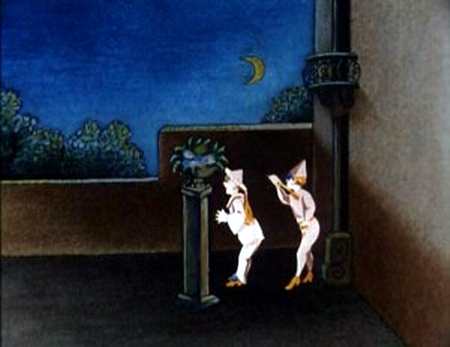
Pauvre Pierrot
It's been a while since I've blogged. Blame work, school, and a bike accident that wasn't but could have been very nasty. I have some fabulous bruises, but that's all.
This morning I've been reading Rachel Zolf's blog The Tolerance Project, a collaborative writing project with eighty writers, artists, and thinkers from across Canada and the United States. Rachel is the author of Human Resources, and winner of the 2008 Trillium Book Award for Poetry. So, why is she in an MFA program? Rachel Zolf is Canadian, and when her female partner got a tenure-track job at a university in the USA, she was not able to legally move with her to New York because their relationship is not legally recognized by US immigration authorities. Becoming a student was really her only other option for obtaining a visa. In her Statement to MFA Workshop October 13, she writes:
...what is most important for my project is that it is a collaborative take on the MFA as an institution within larger state apparatuses. That is the key concept behind my project, a deconstruction of how “authors” and “voices” are created through the process of the MFA, linked with how difference is “tolerated” (or not) in general in the US. I wanted to provoke a look at how the MFA works as a process, by deliberately blowing up the authorial creation and feedback process beyond this room. There is a long tradition in the art world of looking at the workings of art institutions such as art museums and art collecting practices and the creation of the artist as a commodity.If Carolyn Forche had been more present at George Mason and they'd had more funding for me, I might have gone there instead of doing an MA at Georgetown. In fact, I think my critique of MFA programs only became fully developed when I left the east coast and found that not even community colleges wanted to hire me to teach. On the east coast, no one cared that I didn't have an MFA. Most of the major east coast cities have active poetry and arts communities that aren't centered on MFA programs. In other words, I don't think I was fully aware of the degree to which MFA programs were becoming the norm and the ways in which creative writing is professionalized in the US.
I suspect that the farther you get from the city in the US, the more likely MFA programs and educational institutions will be central to art communities. That's an undeveloped argument, I know. But where are the poets going to hang out if you have to drive to the bar? You hang out at school, I guess. Some one give me counter examples.
I'm taking a brief break from typing up my comments to the other people in my poetry workshop--I'm still irritated by the way submitting individual poems to workshop really discourages things like abrupt tonal shifts and strange juxtapositions. I fall into descriptions: this poem is doing this here and that there, that poem is doing that there and this here. I look for strangeness and moments of disorientation. I ask about other poems and refer to previous poems and try to extend the context of the poem as far beyond the workshop as I can. I don't like how workshopping encourages writing for workshopping.
I do like having an immediate group of readers. That's nice. Everyone in my class is intelligent, thoughtful and creative. But more feedback doesn't equal better feedback. Just like after every reading I give there's almost always a woman who is slightly older that me whom I've never met who wants to give me a lot of specific suggestions about the pace of my reading, my clothing, and how I need to learn to breathe differently. I know that my feedback on other people's work has as much to do with me as it does to do with their poems. Obviously.
I am enjoying all the reading and discussion that I'm doing for both the workshop and the other seminar on Modernist aesthetics and art movements. I'm remembering things that I like, reading things I've read, reading a lot of things I haven't read. In some cases, I'm evaluating my relationship to things that I respected but thought I wasn't that interested in.
Example: it turns out that I might actually be more excited by Fanny Howe's work than I previously thought.
Example: now that I've had to read some more Donald Revell, I can be much more articulate about why I really dislike it.
Example: I've never written about Modernist theater or performance. In fact, out of all the major a-g Modernist, I've probably read Artaud and Beckett the least. It's exciting, then, to read them and others and think about a genre that I haven't thought much about.
When I was doing my MA at Georgetown, I felt pressured to make every seminar paper full of amazingly brilliant critical insight that would somehow be relevant to the field. Now I don't mind if I use my term paper as an excuse to think about and learn about things that I want to think about and learn about. I don't care so much about the field. If I have any academic career ahead of me at all, which is doubtful, it's certainly not going to be based on my ability to write normative academic articles. So, in the meantime, I get to read Artaud and Beckett. I get to think about Jacques Copeau and the Théâtre du Vieux-Colombier, especially the years it was in New York, and also Charles Dullin. How Artaud's name comes up constantly in the work of the artists and actors who were busy reviving/changing/rejecting pantomime and thinking about a more physical theater centered on actors and gesture.
Sunday, October 04, 2009
Yeah, I haven't read Notes on Conceptualisms. I would, however, like a "Sobject" T-shirt.
In MFAland, gradschooland. Reading and rereading, among many things, Henry James' "Beast in the Jungle" (which I mistyped as "Beach in the Jungle") and The New Sentence.
I like how "sentence" is "oración" in Spanish, and that it's feminine. La Nueva Oración. In English, a sentence is more about the conventions of writing than speaking. The closest English word to oración is, of course, oration, though oration is rather formal, dignified and ritualized. Latin orationem--"speaking, discourse, language, prayer."
Monday, September 28, 2009
The Sufficiently Hierarchical New Sir Sequels
This is the first complete week of classes at UCSD--but I don't have to be on campus on Monday, so I'm here trying to clean and organize my desk and put away my clothes.
Thus far, the only class I've attended is a graduate movement for theater class with Charlie Oats. It was incredibly fun, and the mime/walking exercises we did were challenging. On Tuesday I have a poetry workshop with Rae, and on Wednesday a class on Modern art movements with Michael. I'm TAing for John Granger's nonfiction class and one of two RAs for the New Writing Series.
Even though I've barely started, I'm already feeling exasperated--not with classes, but with being back in the structure of a university and having to deal with the irritations of interacting and being confined by said structure. Please note, I don't wish that I were still teaching ESL, or that I were still working in business, or even in public policy. It's just been a while since I've had to deal directly with the particular passive-aggressive type of behavior that academic bureaucracies (and probably most types of bureaucracies) enable. In a university, communication tends to happen indirectly and is always filtered through a variety of complicated channels--rarely does someone tell you directly what to do. Of course, there are things that you are absolutely supposed to do, and there are hierarchies, but one can't admit them directly (at least not in the humanities). It takes a while to realize the difference between a suggestion and a command.
I won't bore you all with the details of all the running around me and the other RA have done for the New Writing Series thus far, but it's been quite amazing. I'm looking forward to the Winter quarter when in theory we'll both know what we're doing, how things work, and where things are.
I organized my manuscript files, and found a half-finished manuscript called The Death of a Toad that's a kind of mashup flarf conceptual piece. I don't know what it is. As a manuscript, it suffers from theory head and a lack of energy, but it's full of ridiculous language. One section is called "The Sufficiently Hierarchical New Sir Sequels."
I feel dramatic and melancholy, and like most of the people I love and events I want to go to are on the east coast. It's been too long since I walked home from a party.
Friday, September 18, 2009
Now that I'm beginning something new, it might as well be over.
- Not bored with Language Poetry. Not bored with John Cage, either.
- I haven't even started classes at UCSD yet, and I already have to look for funding for next year from a grant database made for PhD students, not MFAs. Oh well. If I don't get funding for next year, I just won't go back.
- Been grading all. Day. Long. That's why I couldn't meet with you at 4pm.
- Convinced that real estate limits mobility. Unless one is rich or bought one's real estate in the 70s, 80s or before.
- Missing good bookstores.
Monday, September 14, 2009
Countdown to MFA Land
I don't start classes at UCSD in earnest for two more weeks, but I have plenty to do in between now and then with orientations, paperwork, and obsessively calculating the best bus and train routes to get me from Carlsbad to La Jolla sans car. When I lack blogging energy, I resort to lists. So, a list:
- The picture above is of Lester, of course, on his jungle gym in my study. He's been especially happy and defensive of his jungle gym, and the small stuffed elephant he's perched on, ever since he realized that he could pull paper over his head there--just like he does in his cage.
- I've been teaching a weekly hoop dance class with Kristen every Thursday from 4:15-5:15 pm. We meet at Magee Park (258 Beech Avenue Carlsbad, on the West side of the 101 before the lagoon). I think I have about two readers from Carlsbad, but out and hoop with us. Bring your friends. The class is offered on a donation-basis through Bodacious Living Yoga.
- Speaking of yoga, two nights ago I dreamed that I was practicing on a very large flying carpet which was flying over a jungle landscape.
- My father's other brother, David, passed away last week from cancer. David's always been a bit of a mythological figure for me. When he and my dad were kids, David drove a railroad spike through Dad's shoulder (not long after they had started Sunday school). In the early 90s, a horse fell on his head and he was in a coma for two years. After he woke up, he came to live with me, my brother, Dad and Mary in Gaithersburg, Maryland. The night before he arrived I dreamed he barbecued our dog, Cabal. In fact, he and Cabal got along well. For a period of several months, David slept in our living room and wore his cowboy hat to my brother's cross country meets and my flute recitals. Eventually, he left when a woman got in touch with him about his son. He ended up living in Angle Fire, New Mexico, panning for gold and carving walking sticks. My aunt said that he passed away peacefully, surrounded by friends. I am dedicating all my yoga practices to him this week.
Monday, February 23, 2009
And I speak three languages and can do handstands
I am definitely going to be in the MFA program at UCSD next year! I was very ambivalent about applying, but now I'm genuinely excited and looking forward to being in the program. I still have moments when I think something likeWhy do I need an MFA when I have a BA and an MA and 4 years of teaching experience and a book coming out and special collections in Canada collecting my random chapbooks and visual poetry being shown in international exhibitions?
There are several answers to this question.
1. I don't actually need an MFA.
2. If I want to be eligible for jobs, I should have an MFA, which will barely make me eligible and I don't think it should matter but it does etc.
3. The job market sucks and I won't have a degree from either Harvard or Iowa, but going to UCSD does nothing to impact that particular problem.
4. I will have studied with Rae Armantrout, which will be cool.
5. An MFA will help me focus on my creative work in a different way, which I need.
6. San Diego is a community wasteland, so having a teeny bit more community will be, in theory, nice.
7. I may get to work in the library or archive, which would be great, and I've often wondered if library work would suit me. I used to think I was not "detail oriented," but that's crap. I just need to understand the larger context a bit before I can understand details.
8. I am looking forward to a change in my work life.
9. Now I won't have to imagine that all the people with MFAs think they are better than me while at the same time thinking how stupid this imaginary feeling I atribute to them is.
10. I think it will probably be fun.
11. It is fully-funded.
Sunday, December 07, 2008
Reject me! Fund me! Accept me!
This is my statement of interest for UCSD. It's not the best thing that I've ever written, but it does a pretty good job of describing my current creative interests.
Over the past two years, my writing has become increasingly interdisciplinary, borrowing from and integrating a variety of different genres and forms. With my first book coming out in March and several completed poetry manuscripts cluttering my desk, I am in a transitional moment. I am applying to the MFA program at UCSD to develop my creative work in a stimulating, interdisciplinary environment, participate in an expanded community of peers, and work closely with writers and scholars I respect. The MFA program at UCSD is of particular interest to me because it is one of the few programs in the country supportive of innovative and interdisciplinary approaches to literary art. I am also excited by the trans-cultural nature of the program.
I grew up mostly overseas in China, Papua New Guinea, Chile, and Mexico, and when I wasn’t overseas I lived in rural Maine, where many of my friends lived on communal farms. As an undergraduate, I studied Chinese and East Asian history and politics at George Washington University because I wanted to continue to travel in Asia, and I thought I wanted to be a journalist. Really, it was a way of concealing my interest in writing and making it seem professional and practical. During college, I spent between six and ten hours each week in various Chinese classes, and the rest of my courses were devoted to history, politics, and economics. I worked for various non-profit organizations during the school year, and spent most of my summers either Beijing or Singapore working, variously, as an English teacher, translator for a petrochemical company, and web designer.
.
After I graduated, I got a job working in the East Asian department of a non-partisan but mostly democratic public policy organization focused on international security. I spent a lot of time researching and explaining various plans for missile defense systems and going to meetings at the Pentagon where I would talk to Department of Defense bureaucrats about why the People’s Republic of China felt insulted and threatened by US plans for missile defense systems. These meetings typically took place in windowless internal offices decorated with artsy pictures of mushroom clouds, and I was usually the only woman in the room.
When I finally did start going to poetry readings and learning about contemporary poetry in English, I was drawn to the politically and socially engaged poetics of Language poets as well as writers affiliated with the Kootenay School of Writing. However, I was especially drawn to writers engaging issues of translation and gender.
Yunte Huang’s first book, Shi: A Radical Reading of Chinese Poetry, as well as his critical work on the “transpacific displacement” of cultural meanings through twentieth-century America's imaging of Asia, was pivotal to me. In particular, it helped me rethink the problems and pleasures of translation from Chinese to English. A Xu Bing exhibition at the Sackler Gallery in 2001 was also important to my critical thinking about translation—I love his scrolls printed with thousands of imitation Chinese characters.
One of the first larger projects I worked on after college was a procedural translation of several classical Chinese poems, which attempts to highlight—through form and process—my anxious relationship to the creation of a poetic text that can be read as a kind of ethnography that maintains linguistic and cultural boundaries, even as it tries to subvert them. The translations were procedural because, in addition to Yunte Huang and Xu Bing, I’d also been studying Jackson MacLow and John Cage. The final manuscript, Large Waves to Large Obstacles, is coming out as a chapbook from Take Home Project in 2009, with the original Chinese on one side and my procedural translation on the other.
While I was busy investigating translation and conceptual art, I was simultaneously reading a lot of Lyn Hejinian, Bernadette Mayer, and Kathy Acker. All of these writers challenged me to rethink the relationships between form, subjectivity, and materiality. These are the main concerns in my book, Terminal Humming, forthcoming from Edge Books in 2009.
While working on my MA in literature at Georgetown University, I continued to think about these concerns, but became particularly obsessed with the role of pain in the construction of subjectivity, and how the experience/articulation of suffering through sexual and romantic relationships comes to bear on representation and identification. I read Mayer and Acker within a continuum of writers who examine sexual relationships through experimental lyric and narrative forms as a way of highlighting material concerns, critiquing cultural representation, and renegotiating subjectivity. Working through the subject-subject oriented psychoanalytic theories of Jessica Benjamin and Elaine Scarry’s investigations into the experience of pain, My MA thesis brought these critical concerns to bear on Mina "Loy’s Songs to Joannes" and Djuna Barnes’ Nightwood.
In retrospect, I see how my theoretical interests at Georgetown were an extension of the concerns in Terminal Humming. The poems in Terminal Humming oscillate between an insular rhetoric of lyric desire in stanzas and social rhetorics of love and sex, always in some combination of prose, stanzas, procedural pieces, and breath-based space on the page, with bits of narrative only occasionally appearing. My work has always been interdisciplinary, but recently I’ve been exploring and integrating new forms into my work. Specifically, I’ve been thinking about the use of visual non-linguistic materials, narrative, and movement/gesture.
My first teaching job was at the Corcoran College of Art + Design, where many of my students were already accomplished visual artists. Teaching at an art school helped me see poetry as part of larger, more complicated, cultural, historical and multi-disciplinary frameworks. One of my students described drawing as “just making shapes that resemble real shapes.” I started drawing and making visual poems because I thought it would be interesting to attempt something I have no talent for and because I was looking for a way to critically and creatively respond to all the poetry readings I was attending. So, I started doodling during readings, and those were my first visual poems. At this point I have more than a hundred reading responses; if I could get away with it I’d publish them as a book of essays. A complete list of influences for my doodles would very long, but it includes Övind Fahlström, Louise Bourgeois, and bpNichol.
Djuna Barnes, Jean Rhys, Jane Bowles and Paul Bowles are central to my understanding of narrative, but my more recent interest was prompted through exposure to various contemporary experimental fiction writers and through an ongoing exploration of New Narrative, which has only increased since I moved to California. In particular, I’ve been considering how New Narrative and Language poetry mutually inform each other’s concerns with narrative, gender, and identity. Several conversations with Kaplan Harris, as well as his recent scholarship on this subject, have deeply informed my thinking. Narrative strikes me not as incapable of mounting a materialist critique of language, but rather capable in a way different than poetry. In addition to New Narrative writers such as Robert Glück, Dodie Bellamy, Kevin Killian, and Camille Roy, I’m interested in works like Lyn Hejinian and Carla Harryman’s “The Wide Road,” The Transformation, by Juliana Spahr, Selah Saterstrom’s The Pink Institution, Stephanie Young’s most recent book, Picture Palace, and almost everything recently published by Les Figues Press.
All of my work plays with an intense and even exaggerated exploration of life as a female body but also a rejection of that materiality (if that’s even possible). Before I became interested in incorporating gestural elements and movement into my work, I was drawn to writing grounded in voice—an actual, physical voice that forms the base of a line. So, that means I was reading a lot of Bernadette Mayer, whom I’ve already mentioned, and also Joanne Kyger and Eileen Myles. It wasn’t much of an intuitive leap for me to move from voice to movement. Speaking is physical.
With physical movement in mind, I’ve been studying the work of choreographers like Pina Bauch and Martha Graham, whose work emphasized emotion, spontaneity, the erotic, and an exploration of Jungian psychology. Modern dance is dominated by women and often grew out of a desire to thwart cultural control over female bodies—think of Isadora Duncan dancing uncorseted in a white tunic, for example, or Graham’s Greek mythological heroines. Theoretically, I’m opposed to Jungian psychology, and I remain postmodernly obsessed with the fact that our emotions and behavior are socially conditioned. There’s never a moment when we’re free from social constructions. Instead, we participate in and are constrained by an endless dialogue with them. However, I am interested in how stereotypes and mythologies about femininity and female bodies have been used by Feminist artists, and modern dance is a good place to explore that.
Tina Darragh’s work has become increasingly important to me as I consider these feminine stereotypes. Darragh’s work investigates such stereotypes in a hybrid, interdisciplinary way and demonstrates how materialist critique, Feminism, non-linguistic elements, and performance can successfully exist together—albeit with plenty of tension—in a text. Darragh is a poet I know from Washington, DC often associated with Language poetry. In 1999 she started working on a project that eventually became opposable dumbs, a multigenre piece that combines reportage, theater, letters of protest, visual pieces, and notes that examine and think about pain, hysteria, animal subjectivity, economics, labor unions, and Feminism. Even after years of hearing her perform different parts of this piece and now reading the 2007 “project report” I have trouble summarizing it. Her work has many possible sources that connect and expand into other possible sources. It’s investigative and process-oriented, but the process and investigation are always shifting.
In addition to modern dance choreographers and Tina Darragh, I am inspired by my peers and slightly older contemporaries, many of whom have been incorporating gestural elements and movement into their work—and here I am thinking especially of Laura Elrick and Rodrigo Toscano. Elrick’s recent performance pieces stem from, as she noted in her statement for the Positions Conference in Vancouver, August 2008, “a desire to elaborate a social poetics that does not rely exclusively on language operations to enact and continually ‘post’ its resistance to the hegemony.” I’m equally intrigued by Toscano’s idea of a performance text being, as he noted in his statement for the Positions Conference, “a semi-contained social-psychological crisis, a formalization of an incipient collective consciousness from the vantage point of the collapse of a previous collective consciousness.” At recent readings, I’ve been looking to their work as well as drawing on my own background in modern dance to incorporate movement and polyvocality into my performances. Quite frankly, I’m not sure how it’s working. Thus far, I’ve created musical and sound texts to accompany myself while reading, and I’ve performed both choreographed and improvised movement. Performing my poems while upside down in a handstand gives the performance a strange combination of camp and discomfort.
I want my poems and performances to highlight risk and vulnerability—aesthetically, politically, psychologically—and I want them to be a bit out of control. Extending poetic praxis into multigenre and non-linguistic forms feels risky and necessary. It’s also fun. As with any innovative art, there is always a danger that the reader/viewer will not be able to or not want to make the intuitive leaps offered, but playing with that danger is, to me, the point.
My creative interests are interdisciplinary and well suited to the resources of the MFA program at UCSD. The creative and critical work of Rae Armantrout, Eileen Myles and Michael Davidson is of immense interest to me given my work in avant-garde poetry and gender, and I am certain I would like to work with them. Anna Joy Springer’s own innovative fiction and interest in Kathy Acker and intermedia is also relevant to my own concerns, as is Sarah Shun-lien Bynum’s work in innovative and speculative fiction. Moreover, Wai-lim Yip’s work in comparative poetics, modernism, and translation theory is also very relevant to my interests, and I would hope to study with him. Finally, the Archive for New Poetry is a major resource that I would be very glad to have regular have access to.
As I mentioned above, I can think of few MFA programs that could support the cultural, linguistic, aesthetic and theoretical concerns of my various creative projects. The interdisciplinary MFA program at UCSD has expertise in contemporary experimental poetry and fiction, feminism, and comparative modernism, and I would be excited to pursue my studies there.
Over the past two years, my writing has become increasingly interdisciplinary, borrowing from and integrating a variety of different genres and forms. With my first book coming out in March and several completed poetry manuscripts cluttering my desk, I am in a transitional moment. I am applying to the MFA program at UCSD to develop my creative work in a stimulating, interdisciplinary environment, participate in an expanded community of peers, and work closely with writers and scholars I respect. The MFA program at UCSD is of particular interest to me because it is one of the few programs in the country supportive of innovative and interdisciplinary approaches to literary art. I am also excited by the trans-cultural nature of the program.
I grew up mostly overseas in China, Papua New Guinea, Chile, and Mexico, and when I wasn’t overseas I lived in rural Maine, where many of my friends lived on communal farms. As an undergraduate, I studied Chinese and East Asian history and politics at George Washington University because I wanted to continue to travel in Asia, and I thought I wanted to be a journalist. Really, it was a way of concealing my interest in writing and making it seem professional and practical. During college, I spent between six and ten hours each week in various Chinese classes, and the rest of my courses were devoted to history, politics, and economics. I worked for various non-profit organizations during the school year, and spent most of my summers either Beijing or Singapore working, variously, as an English teacher, translator for a petrochemical company, and web designer.
.
After I graduated, I got a job working in the East Asian department of a non-partisan but mostly democratic public policy organization focused on international security. I spent a lot of time researching and explaining various plans for missile defense systems and going to meetings at the Pentagon where I would talk to Department of Defense bureaucrats about why the People’s Republic of China felt insulted and threatened by US plans for missile defense systems. These meetings typically took place in windowless internal offices decorated with artsy pictures of mushroom clouds, and I was usually the only woman in the room.
When I finally did start going to poetry readings and learning about contemporary poetry in English, I was drawn to the politically and socially engaged poetics of Language poets as well as writers affiliated with the Kootenay School of Writing. However, I was especially drawn to writers engaging issues of translation and gender.
Yunte Huang’s first book, Shi: A Radical Reading of Chinese Poetry, as well as his critical work on the “transpacific displacement” of cultural meanings through twentieth-century America's imaging of Asia, was pivotal to me. In particular, it helped me rethink the problems and pleasures of translation from Chinese to English. A Xu Bing exhibition at the Sackler Gallery in 2001 was also important to my critical thinking about translation—I love his scrolls printed with thousands of imitation Chinese characters.
One of the first larger projects I worked on after college was a procedural translation of several classical Chinese poems, which attempts to highlight—through form and process—my anxious relationship to the creation of a poetic text that can be read as a kind of ethnography that maintains linguistic and cultural boundaries, even as it tries to subvert them. The translations were procedural because, in addition to Yunte Huang and Xu Bing, I’d also been studying Jackson MacLow and John Cage. The final manuscript, Large Waves to Large Obstacles, is coming out as a chapbook from Take Home Project in 2009, with the original Chinese on one side and my procedural translation on the other.
While I was busy investigating translation and conceptual art, I was simultaneously reading a lot of Lyn Hejinian, Bernadette Mayer, and Kathy Acker. All of these writers challenged me to rethink the relationships between form, subjectivity, and materiality. These are the main concerns in my book, Terminal Humming, forthcoming from Edge Books in 2009.
While working on my MA in literature at Georgetown University, I continued to think about these concerns, but became particularly obsessed with the role of pain in the construction of subjectivity, and how the experience/articulation of suffering through sexual and romantic relationships comes to bear on representation and identification. I read Mayer and Acker within a continuum of writers who examine sexual relationships through experimental lyric and narrative forms as a way of highlighting material concerns, critiquing cultural representation, and renegotiating subjectivity. Working through the subject-subject oriented psychoanalytic theories of Jessica Benjamin and Elaine Scarry’s investigations into the experience of pain, My MA thesis brought these critical concerns to bear on Mina "Loy’s Songs to Joannes" and Djuna Barnes’ Nightwood.
In retrospect, I see how my theoretical interests at Georgetown were an extension of the concerns in Terminal Humming. The poems in Terminal Humming oscillate between an insular rhetoric of lyric desire in stanzas and social rhetorics of love and sex, always in some combination of prose, stanzas, procedural pieces, and breath-based space on the page, with bits of narrative only occasionally appearing. My work has always been interdisciplinary, but recently I’ve been exploring and integrating new forms into my work. Specifically, I’ve been thinking about the use of visual non-linguistic materials, narrative, and movement/gesture.
My first teaching job was at the Corcoran College of Art + Design, where many of my students were already accomplished visual artists. Teaching at an art school helped me see poetry as part of larger, more complicated, cultural, historical and multi-disciplinary frameworks. One of my students described drawing as “just making shapes that resemble real shapes.” I started drawing and making visual poems because I thought it would be interesting to attempt something I have no talent for and because I was looking for a way to critically and creatively respond to all the poetry readings I was attending. So, I started doodling during readings, and those were my first visual poems. At this point I have more than a hundred reading responses; if I could get away with it I’d publish them as a book of essays. A complete list of influences for my doodles would very long, but it includes Övind Fahlström, Louise Bourgeois, and bpNichol.
Djuna Barnes, Jean Rhys, Jane Bowles and Paul Bowles are central to my understanding of narrative, but my more recent interest was prompted through exposure to various contemporary experimental fiction writers and through an ongoing exploration of New Narrative, which has only increased since I moved to California. In particular, I’ve been considering how New Narrative and Language poetry mutually inform each other’s concerns with narrative, gender, and identity. Several conversations with Kaplan Harris, as well as his recent scholarship on this subject, have deeply informed my thinking. Narrative strikes me not as incapable of mounting a materialist critique of language, but rather capable in a way different than poetry. In addition to New Narrative writers such as Robert Glück, Dodie Bellamy, Kevin Killian, and Camille Roy, I’m interested in works like Lyn Hejinian and Carla Harryman’s “The Wide Road,” The Transformation, by Juliana Spahr, Selah Saterstrom’s The Pink Institution, Stephanie Young’s most recent book, Picture Palace, and almost everything recently published by Les Figues Press.
All of my work plays with an intense and even exaggerated exploration of life as a female body but also a rejection of that materiality (if that’s even possible). Before I became interested in incorporating gestural elements and movement into my work, I was drawn to writing grounded in voice—an actual, physical voice that forms the base of a line. So, that means I was reading a lot of Bernadette Mayer, whom I’ve already mentioned, and also Joanne Kyger and Eileen Myles. It wasn’t much of an intuitive leap for me to move from voice to movement. Speaking is physical.
With physical movement in mind, I’ve been studying the work of choreographers like Pina Bauch and Martha Graham, whose work emphasized emotion, spontaneity, the erotic, and an exploration of Jungian psychology. Modern dance is dominated by women and often grew out of a desire to thwart cultural control over female bodies—think of Isadora Duncan dancing uncorseted in a white tunic, for example, or Graham’s Greek mythological heroines. Theoretically, I’m opposed to Jungian psychology, and I remain postmodernly obsessed with the fact that our emotions and behavior are socially conditioned. There’s never a moment when we’re free from social constructions. Instead, we participate in and are constrained by an endless dialogue with them. However, I am interested in how stereotypes and mythologies about femininity and female bodies have been used by Feminist artists, and modern dance is a good place to explore that.
Tina Darragh’s work has become increasingly important to me as I consider these feminine stereotypes. Darragh’s work investigates such stereotypes in a hybrid, interdisciplinary way and demonstrates how materialist critique, Feminism, non-linguistic elements, and performance can successfully exist together—albeit with plenty of tension—in a text. Darragh is a poet I know from Washington, DC often associated with Language poetry. In 1999 she started working on a project that eventually became opposable dumbs, a multigenre piece that combines reportage, theater, letters of protest, visual pieces, and notes that examine and think about pain, hysteria, animal subjectivity, economics, labor unions, and Feminism. Even after years of hearing her perform different parts of this piece and now reading the 2007 “project report” I have trouble summarizing it. Her work has many possible sources that connect and expand into other possible sources. It’s investigative and process-oriented, but the process and investigation are always shifting.
In addition to modern dance choreographers and Tina Darragh, I am inspired by my peers and slightly older contemporaries, many of whom have been incorporating gestural elements and movement into their work—and here I am thinking especially of Laura Elrick and Rodrigo Toscano. Elrick’s recent performance pieces stem from, as she noted in her statement for the Positions Conference in Vancouver, August 2008, “a desire to elaborate a social poetics that does not rely exclusively on language operations to enact and continually ‘post’ its resistance to the hegemony.” I’m equally intrigued by Toscano’s idea of a performance text being, as he noted in his statement for the Positions Conference, “a semi-contained social-psychological crisis, a formalization of an incipient collective consciousness from the vantage point of the collapse of a previous collective consciousness.” At recent readings, I’ve been looking to their work as well as drawing on my own background in modern dance to incorporate movement and polyvocality into my performances. Quite frankly, I’m not sure how it’s working. Thus far, I’ve created musical and sound texts to accompany myself while reading, and I’ve performed both choreographed and improvised movement. Performing my poems while upside down in a handstand gives the performance a strange combination of camp and discomfort.
I want my poems and performances to highlight risk and vulnerability—aesthetically, politically, psychologically—and I want them to be a bit out of control. Extending poetic praxis into multigenre and non-linguistic forms feels risky and necessary. It’s also fun. As with any innovative art, there is always a danger that the reader/viewer will not be able to or not want to make the intuitive leaps offered, but playing with that danger is, to me, the point.
My creative interests are interdisciplinary and well suited to the resources of the MFA program at UCSD. The creative and critical work of Rae Armantrout, Eileen Myles and Michael Davidson is of immense interest to me given my work in avant-garde poetry and gender, and I am certain I would like to work with them. Anna Joy Springer’s own innovative fiction and interest in Kathy Acker and intermedia is also relevant to my own concerns, as is Sarah Shun-lien Bynum’s work in innovative and speculative fiction. Moreover, Wai-lim Yip’s work in comparative poetics, modernism, and translation theory is also very relevant to my interests, and I would hope to study with him. Finally, the Archive for New Poetry is a major resource that I would be very glad to have regular have access to.
As I mentioned above, I can think of few MFA programs that could support the cultural, linguistic, aesthetic and theoretical concerns of my various creative projects. The interdisciplinary MFA program at UCSD has expertise in contemporary experimental poetry and fiction, feminism, and comparative modernism, and I would be excited to pursue my studies there.
Thursday, December 04, 2008
Sorry, still alienated
And, like most of the people I've communicated with recently, overburdened with work. In my case though, the work isn't so bad, but there's a lot of it: 5 hours a day of teaching + several design contracts + MFA statement of interest. The design projects are fun, and I'll actually been playing with creating some nifty typeface effects, which means that the end result of both projects will, I hope, be some of the best work I've done yet.
I'll post my statement of interest after I send it off tomorrow. Only a deadline will prevent me from noodling with it further.
xo
Monday, November 03, 2008
Sucking it up
I have planned my blue outfit for tomorrow. I've already voted. I don't feel calm about anything, but for now there is nothing to do but wait for results and hope that there are results by tomorrow evening. Please vote for Obama if you haven't already. A Democratic presidency might help decrease the number of wars our country wages and restore some small ounce of fiscal responsibility. I'm not holding my breath for universal heath care though, or actual money spent on education. I wish, though.
I am trying to finish my statement of interest for the MFA program.
It's getting dark, and Lester has fallen asleep on my knee.
I've been thinking about my least favorite asanas. I have two: Urdhva Mukha Svanasana (upward facing dog) and Dhanurasana (Bow Pose)--both are upward facing backbends instead. I'm not a big fan of sticking my chest out. Urdhva Mukha Svanasana in particular makes me feel like I'm a bust carved into the prow of a ship. Or a hood ornament. I never feel like it's actually opening my chest or shoulders. Instead, I feel like my shoulders are up around my ears and my wrists are going to pop off. Dhanurasana makes me feel heavy. Instead of opening up the front of my body, I feel like my knees are going to pop off.
I find it interesting (to use the blandest, least specific word possible), that my two least favorite asanas are poses that are meant to open the heart chakra, build courage and stamina, and create energy that encourages us to reach out toward others.
~
I am back from yoga. We practiced my third least favorite asana: Virasana (Hero Pose)--yet another asana that opens the front of the body. I have eaten a nice pear. I have made a list of all the good things about being in an MFA program and having an MFA. I have congratulated myself on...I forgot was I was going to write, so that means I have forgotten about what I congratulated myself on.
Labels:
Anahata Chakra,
daily,
MFA,
pain,
US Election 2008,
yoga
Sunday, October 12, 2008
Stall Dos
I am, in fact, applying to MFA programs this year. I once vowed I would never, ever, under any circumstances get an MFA. But vows are generally stupid, as I now know. Besides, I made that vow in a time and place where/when no one around really cared about MFAs. In DC, an MFA didn't prevent me from teaching at the Corcoran, because DC is a city, and cities have art communities that, while they include universities, are not defined and created by them. However, most of the USofA is suburban, not urban. With a new, interesting MFA program at UCSD, I might as well apply. Hey, if you don't have an MFA yet, why don't you apply, too...
I frequently say, "I want an MFA so I can get crappy adjunct work." However, as Mark has pointed out, I already get crappy adjunct work. But I want better crappy adjunct work. I have no delusions about getting a tenure-track creative writing job, but a local MFA might make me more attractive to area community colleges. Maybe I'm guilty of wanting change for change sake. A dangerous want, but oh well.
Tangent: I found my female Robin Hood-type doll. She has a Robin Hood hat and everything. I played Robin Hood in 6th grade. The play was in French, which seems ironic given the history of the Normans and Saxtons.
I frequently say, "I want an MFA so I can get crappy adjunct work." However, as Mark has pointed out, I already get crappy adjunct work. But I want better crappy adjunct work. I have no delusions about getting a tenure-track creative writing job, but a local MFA might make me more attractive to area community colleges. Maybe I'm guilty of wanting change for change sake. A dangerous want, but oh well.
Tangent: I found my female Robin Hood-type doll. She has a Robin Hood hat and everything. I played Robin Hood in 6th grade. The play was in French, which seems ironic given the history of the Normans and Saxtons.
Thursday, January 17, 2008
I want a writing MFA I don't want one
Having an MFA would do almost nothing for my publication possibilities, but it would help me get adjunct work. Wow, that's motivating!
I'm feeling arrogant and impatient: I'm a really good writer. I'm a really good teacher, I can help you learn grammar and writing and theory, I'm extremely intelligent and totally cute--and my social skills are top notch. Plus, I can do a really solid handstand. I am sure I will have a book out in the next year or so. Most writers I respect, even ones with MFAs, say MFAs aren't necessary (or they say that everyone needs a PhD now). Necessary for what? Apparently, an MFA is necessary for adjunct work. Blech.
I am considering, again, doing an MFA in art. Not writing. I don't want to be anyones academic superstar, I want to be able to make a living and not go crazy. I am feeling impatient about my writing and professional careers because, I suppose, they are actually going quite well. So I want them to be even better. Now.
The new year has begun for real! The holidays are over! All worries that I have not worried for weeks are beginning to return!
I'm feeling arrogant and impatient: I'm a really good writer. I'm a really good teacher, I can help you learn grammar and writing and theory, I'm extremely intelligent and totally cute--and my social skills are top notch. Plus, I can do a really solid handstand. I am sure I will have a book out in the next year or so. Most writers I respect, even ones with MFAs, say MFAs aren't necessary (or they say that everyone needs a PhD now). Necessary for what? Apparently, an MFA is necessary for adjunct work. Blech.
I am considering, again, doing an MFA in art. Not writing. I don't want to be anyones academic superstar, I want to be able to make a living and not go crazy. I am feeling impatient about my writing and professional careers because, I suppose, they are actually going quite well. So I want them to be even better. Now.
The new year has begun for real! The holidays are over! All worries that I have not worried for weeks are beginning to return!
Subscribe to:
Posts (Atom)