Showing posts with label poetry. Show all posts

Monday, August 24, 2009

Trip Report Part Four: Brussels


I loved Brussels instantly. If you're skeptical of my ability to love a place I don't really know, then know that I felt immediately at ease there--relaxed and strangely unalienated in a way that's difficult to feel in unfamiliar places. Bruxelles (yes, I'm going to spell it differently every other time I write it) was very familiar in many ways--it's a cosmopolitan, international, multicultural political city with a reputation for being cool but not as cool as it's close neighbors Paris and Amsterdam. I don't want to overstate the ways in which it's similar to DC, but the similarities are there.

When Mark and I arrived at Bruxelles-Midi, it was nice to actually get out and leave the station instead of waiting in it, as we had already done twice, to catch a train somewhere else. It's not a huge city (a little over one million people live there), but it's incredibly diverse. Aside from the French and Dutch speaking Belgians, there are people from all over Europe as well as north Africa, Turkey, Asia, and elsewhere. There are some estimates that about half of the people who live in Brussels are not from Belgium, and a substantial number of people who live in Bruxelles speak neither French nor Dutch as a first language. All over Bruxelles, people speak to each other in second, third or fourth languages, and it's difficult to make accurate assumptions about where people are from. I love this.

We experienced a slightly higher than normal level of disorientation when we left the station, and it wasn't clear whether we needed to catch the metro, tram or premetro to get up to our hotel in Ste-Catherine. My first encounter with a stranger in Bruxelles was indicative of all the others: I asked a woman, in French, which metro, tram or premetro we should get on, and which direction we should go. She was incredibly polite and patient and didn't switch into English or ask where I was from. Instead, she showed me on the map where we had to go, and pointed me toward the premetro station (which was, counter-intuitively, underground).


Ste. Catherine (shown above) was easy to get to, and, as it turns out, a hip place to stay--not that I knew that when I booked our hotel. I just chose that location because I didn't want to stay in one of the overpriced and touristy places on the Grand Place. The neighborhood had a nice combination of both homey and fancy bars and restaurants, as well as several Asian food markets.

In fact, the presence of Asian food markets made Ste. Catherine (and Brussels in general) seem very different from Paris, for example. In Paris, you should speak French, and if you would like to eat food that is not French, you should order it in a French way. Paris does have plenty of culturally mixed neighborhoods--but they are exactly that--specific neighborhoods, like Belleville. Aside from kabob shops, ethnic restaurants and markets in Paris don't seem to exist much outside of those specific neighborhoods. I love French food, and could gladly live on crepes, cheese and charchuterie until I died from a heart attack. Still, I felt it was significant to see such cultural variety in food in a neighborhood without any special multicultural distinction.


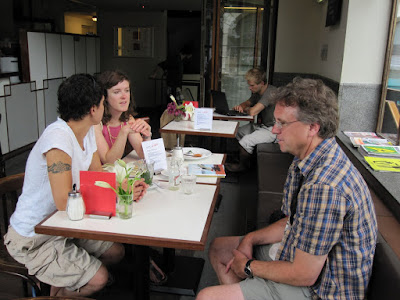
We met Philip Meersman and Rozalina Petrova (both shown in the very first picture) in front of the church on Ste. Catherine and walked towards Place St-Géry. Philip was one of the people who performed after Mark and I read in Ghent. I hesitate to characterize Philip's work--I wouldn't call him a sound poet, because that seems too narrow a term for the kind of diverse work he makes. While he clearly is interested in the relationship between sound, image, language and meaning (the poem he performed in Ghent was in six languages) he also works in theater and plastic arts. It's a bit cheesy of me, but I'm going to quote Mark's description of the performance, since I think it is both accurate and insightful:
Philip Meersman also performed a poem that was not technically a sound poem but that solidified my impression about the relation between sound poetry and cultural context. His poem was in six different languages, not all of which were known to any single person in the room except for him, with the result that at least some portion of his poem was only a sound poem for every member of the audience. It wasn’t meant as a display of language virtuosity, though it certainly was also that, but as a very pointed exploration of what it means to be able to understand other people or not.
Even after just a few hours in Brussels, it was easy for me to see why a writer would want to work with a variety of languages. Here's a brief quote from one of Philip's poems, "La paradoja del paradero del comienzo (Una localización española)," to give you more of an idea of some of the stuff he does:

Preguntas y problemas:
Dónde está el coche
Dónde está mí
Dónde está me
Dónde está yo?
teoría atómica
teoría cuántica
teoría de la relatividad
teoría del caos

Dónde está la profesora

Dónde está la consejera
Dónde está el examen
This poem (you can read the rest of it here) makes me want to return to a project I stared ages ago working with some of the text in Practical Chinese Reader Volumes One and Two.

The weather was wonderful, and Philip and Rozalina are both great conversationalists, so after scoring an outdoor table at a bar across from Les Halles St-Géry, we easily passed several hours talking (and drinking--in my case, a pleasantly sour geuze). Afterward, I had a notebook full of recommendations for everything from where we should eat to which chocolate shop was the best. For posterity, here is a picture of the Halles St-Géry, the point from which all distances in Belgium are measured:


Eventually, Philip and Rozalina had to head home to prepare for work as well as the huge Ghent Festival. We parted ways, and Mark and I went off to eat some very delicious Thai food. The two women sitting at the table next to us could have easily been State Department bureaucrats. They were EU bureaucrats, of course; I felt right at home. Later we wandered back towards Ste. Catherine to a local bar off the square. I don't remember the name, but the few folks in there seemed overly suprised that any tourists would be there at all. Two men sitting next to us struck up a conversation, which me more or less managed in French, Spanish and English--a pretty typical encounter in Brussels.


The next morning I went out to the original flagship location of Le Pain Quotidien, just around the corner from our hotel, for coffee and a croissant. After that, Mark and I walked over to the Grand Palace (immediately above) and farther along to the Royal Quartier and the new Musée René Magritte at the Musées royaux des Beaux-Arts de Belgique. I have an unfortunate mental block with Surrealist painters--I love how Magritte plays with the difficulty of reconciling words, images and objects, but did he have to paint so many nude women? The history of art is the history of painting nude women, I suppose, and I like Magritte enough to be frustrated with him. Still, the new museum houses the largest collection of his work that exists, including a few films. In fact, if I'd had the luxury and time to go back, I would have especially liked to spend more time with the films.

After the museum, we attempted to eat some sandwiches in the lovely Parc de Bruxelles and only barely managed. It rained, but we found shelter under some trees. Here's Mark post-lunch:


After lunch, we went back in to see the main collection of the Musées royaux des Beaux-Arts. The collections were strangely organized and difficult to navigate. For me, the highlight of this visit was Hieronymus Bosch's Temptation of St. Anthony.


On our way back to the hotel, we walked past La Fleur en Papier Doré, the bar where René Magritte and later members of the COBRA movement hung out. We didn't have a drink there, though; it was kind of expensive. After a rest, a shower, and a quick run on my part to Elisabeth Chocolatier for chocolate and cookies, we went back out to La Mort Subite for a pre-dinner beer. The geuze was the best I had the entire trip. Why isn't geuze more readily available here in the US? Sigh.


After La Mort Subite, we wandered (we did a lot of wandering in Brussels) back over to the area around the Grand Palace to sit in another bar and, yes, drink another beer--they had Delirium Tremens on tap! Later, we ate dinner outside at a different but equally tasty Thai restaurant back in Ste. Catherine. It poured rather fantastically right after we finished our meal, so we took shelter at Bizon Blues--a bar that was styled like an American place even though they seemed to play mostly British rock. We enjoyed some jenever and then a Rochefort 10. The Rochefort 10 was good, but I think the 8 is still my favorite; it's just as flavorful, and less boozy.

We ended our evening at the Monk, and I really don't remember what I drank there--that's the kind of effect that a Rochefort 10 has! Still, I loved how the bartender moved in and out of different languages without even flinching. The Monk was cool, but not too cool:


Mark and I spent less time in Brussels than anywhere else on our trip, but, as I've already said, I really enjoyed my time there. Having spent much of my life as an expat, it was so comforting to be in a city where everyone spoke a different language and where, for the most part, that was ok. I could live in Brussels, and I mean that in a practical way as well as an oh-I-wish-I-wish kind of way. The weather there sucks, but I live in a place known for its great weather, and truly, if weather is the first thing that people mention about a place, you know that means that the rest of it is maybe not worth mentioning.

Wednesday, August 05, 2009

Trip Report Part Three: Amsterdam


I'm going to resist blogging about fashion, teaching ESL again, health care, the f-ed up state of California, Flarf, and disjunction and instead focus on the third part of my trip with Mark: Amsterdam. When we were still in the planning stages of the trip, Tom Orange said (over the phone) "well, are you going to Amsterdam?" We blinked, a little stupidly perhaps, and started planning to go to Amsterdam. And I'm so glad we did. While I loved Paris, I felt quite at home in Amsterdam among the bicycles, cheese shops, drugs, prostitution, pragmatism, canals, fries, art, boutiques selling fashionable bicycle-friendly clothing and the fabulous socialist health care system.

On the 13th, we took a very easy train from Ghent to Amsterdam, through Brussels. In theory, it's quicker to go through Antwerp, but in reality it rarely is--Helen said that the train connections in Antwerp don't always work very well, and the communication between Belgian and Dutch trains is often, well, off.

After a disorienting exit on the south side of the train station in Amsterdam, we found our way to our apartment in the Jordaan district, which was close enough to the city center to walk but far enough away so that it was a bit calmer and there were fewer 20-some British youths smoking up. All of Amsterdam is ridiculously beautiful, Jordaan in particular--it's full of canals, bars, cafes, vintage clothing stores, boutiques, and cheese shops (more on those later). We walked around the neighborhood, bought a few things to keep in our apartment refrigerator (beer, milk, cereal & bananas). That evening, we headed down to De Pijp to meet with Cralan Kelder.

Cralan was one of the editors of Versal, the print publication of wordsinhere, a writer’s collective based in Amsterdam. Cralan grew up in Amsterdam, if I remember correctly, went to school in the states, and then returned to Amsterdam. It was interesting to talk with him about the different writing and arts communities there. He pointed us towards Boekie Woekie, an artist-run bookstore of artist books and visual poetry. It was closed every time we went by, but it seemed very cool.

Although Cralan, his partner and his children were all getting reading to fly to the US the next day, he still made time to hang out with Mark and I. The three of us and his daughter went in search of some Ethiopian food, but unfortunately the restaurant was closed. Never mind. Instead, we wandered through the Sarphatipark to a falafal place not far from the Albert Cuypmarkt. It's too bad that I don't have a decent picture of Cralan, or of the falafals or the french fries we had, which were easily the best we ate on the entire trip. But I do have a picture of the park:


The sun was out even later in Amsterdam than in either Paris or Ghent, so we still had plenty of light in the sky when we had to eventually leave Cralan to his packing. We headed back to our neighborhood and found a bar in which to spend the rest of our evening hours. I love travel because it brings be in contact with ideas, things and people that are unfamiliar to me, but I also love the way time slows down in a new place. While we sat at that bar on our first evening in Amsterdam, it felt a bit like we'd always been sitting in a bar on a pleasant summer evening in Amsterdam. It was a pleasant feeling.


The next morning we walked down to the Van Gogh museum--Cralan had lent us his annual passes, so we didn't have to wait in the long line to get in. The museum has an impressive collection of Van Gogh, obviously, but also a collection of other 19th-century art--mostly by Van Gogh's friends and contemporaries. I'm always disturbed by the story of Van Gogh's life--and thinking about it makes me thankful that I am both physically and mentally well--but I was happy to see several pieces I'd never seen, including "Wheatfield with Crows."

After the museum, we walked back up into the Jordaan district, and stopped at De Kaaskamer Van Amsterdam, a cheese shop that specializes in local Dutch varieties--I wanted to buy something of everything, but instead I limited myself to several different types of farmhouse Goudas--one old (Rypenaer V.S.O.P.), one young (Le Vieux Gris) and then an organic medium-soft gouda-like cheese called Boeren that the cheese guy suggested. How happy am I in this picture?


We eventually made our way to a small bar called De Zotte that stocked a variety of Belgian beers (no, we weren't sick of Belgian beer. In fact, we are still not sick of Belgian beer). The bar was quiet, and a good place to spend a rainy late afternoon.


We ate a very basic and healthy dinner of sandwiches at a sort of loungey place by a canal. More memorable was the very tasty cold jenever we had at a very cozy brown cafe later that evening.


The rain stopped rather late in the evening, so our last stop was at a lively outdoor cafe back in Jordaan. I was done with alcoholic at that point, so I got some fresh mint tea--something that people all over Amsterdam seem to drink at any time of day.

The next morning (the 15th of July), we headed to Cafe De Balie to meet Megan Garr and Sarah Ream, both writers, and editors of Versal magazine, which I mentioned above. Versal seems to do a good job of being a forum for many of the translocal European literary communities as well as other writers and writing communities outside of Europe that have a complex relationship to being local or, er, not local--there are commonalities that exist which aren't necessarily the same as a totalizing kind of globalization. Megan's editorial in issue 7 of Versal has some interesting thoughts about translocality and is worth getting a hold of.

In my post on Brussels, I'll talk more about how relatively calm and at home I feel in communities and places where there's a kind of localism that isn't completely based on geography, culture or even language. For now, here's a picture of Megan, Sarah and Mark enjoying mint tea and translocal conversation:


Eventually, Megan and Sarah had to head on their way, and Mark and I wandered down the road to Cafe De Jaren for some lunch and to meet Jaap Blonk, Rozalie Hirs, Samuel Vriezen, and Frank Keizer. Mark blogged in some detail about the sound, music and poetry work that all of these writers do. I began thinking more about some of my own attempts to work with sound and music in recent performances--some more interesting than others, obviously--and again came to the conclusion that I would like to work with some of the languages I know other than English. But how? Well, we'll see. I'm looking forward to playing with some of these ideas when I start at UCSD in the fall.


After lunch, Rozalie had to head off, but Samuel, Jaap, and Frank took us over to Poëzie Perdu (above), a bookstore and performance space that hosts writers, musicians and other artists throughout the year. There's a fairly extensive archive of podcasts from previous events on the website. Here's a picture of Frank and Samuel showing us around the bookstore, which left me wishing that I could read Dutch, and also eager to start some translation projects from languages that I actually can read:


That afternoon, we wandered back to our apartment via the red-light district, which was noticeably full of British people and actually quite tame. In the evening, we headed back to the edge of that same district for dinner, where I ordered a "goat cheese burger" that ended up being made entirely of cheese, instead of just a burger with goat cheese on top of it. Next to us at the restaurant was a table of about six or seven standardly handsome young men who kept up a running commentary of all the women who walked by. They were offensive, but I liked how the moved between Dutch and a very American style English. After dinner we went into another brown cafe for some jenevers. You can see the old bottles of genever in the window of this picture:


As I've already said, I'm glad that we went to Amsterdam, and I'm glad that we managed to connect with so many writers and artists there--not an easy thing to do during the summer when many people are on vacation and out of town. Since this post has taken me forever to write, I'm now going to try and end it quickly (and gradually correct typos later): I loved being in Amsterdam, was really excited by the poets and musicians I met and could easily see living there.


In the next few days I'll post something about Brussels!

Friday, October 31, 2008

Stan Apps et Mathew Timmons at Agitprop in Northpartk, November 1

We hope you can join us this Saturday, November 1 at 7 pm for the next reading in the Agitprop reading series at Agitprop Gallery (2837 University Ave in North Park, entrance on Utah, a few blocks west of 30th Street), featuring STAN APPS and MATHEW TIMMONS. Wine and snacks will be served. Donations to the gallery are always appreciated.

Stan Apps is a poet and essayist living in Los Angeles. His books of poems include soft hands (Ugly Duckling Presse), Princess of the World in Love (Cy Press), Info Ration (Make Now Press) and God's Livestock Policy (Les Figues Press). A collection of essays is underway from Combo Books. Recent work has appeared in Joyland: a hub for short fiction (http://www.joyland.ca/home/los_angeles), Try Magazine, Abraham Lincoln, Ecopoetics, and the Icelandic webzine Tregawott. Stan ekes out a living as an adjunct college instructor, teaching the poor to write short persuasive essays.

Mathew Timmons co-edits/curates Insert Press (w/ Stan Apps), LA-Lit (w/ Stephanie Rioux) and Late Night Snack (w/ Harold Abramowitz). His collaboration with visual artist Marcus Civin, a particular vocabulary (P S Books), is forthcoming, and his work may be found in various journals, including: Sleepingfish, P-Queue, Holy Beep!, Flim Forum, The Physical Poets, NōD, PRECIPICe, Or, Moonlit, aslongasittakes, eohippus labs and The Encyclopedia Project. He teaches interdisciplinary arts and writing workshops for CalArts School of Critical Studies.

We hope to see you there and for all festivities afterwards!

AGITPROP POETRY SERIES
Saturday, November 1
7:00pm
AGITPROP Gallery
2837 University Ave in North Park. Entrance on Utah.

Friday, February 29, 2008

NEW Triple Threat Reading Series

Mark has a good blog post about the ways in which San Diego is and is not a poetry city. I'm simply posting the information about the reading this Saturday--I'll be there, hopefully with freshly manicured hands and pedicured toes. Yes--a reading in San Diego is that exciting.

NEW Triple Threat Reading Series--sponsored by 3 San Diego Small Presses: 1913 Press (ed. Sandra Doller), Kuhl House Press (ed. Ben Doller), Tougher Disguises Press (ed. James Meetze) announces its inaugural event...

Come one, come all to the first reading in North Park's new and explosive series. We begin with Noah Eli Gordon & Joshua Marie Wilkinson who are reading in support of their fresh new collaborative book Figures for a Darkroom Voice.

Agitprop Gallery in North Park
2837 University Ave. San Diego, California 92104
(entrance to the gallery is actually on Utah)
7:00pm Saturday, March 1st.

Noah Eli Gordon's first book, The Frequencies, was published by San Diego's own Tougher Disguises Press in 2003. Since then, he has had five other books appear, including Novel Pictorial Noise, which was selected by John Ashbery for the National Poetry Series, and published last year by Harper Perennial. Last year also saw the release of Figures for a Darkroom Voice, a book
written in collaboration with Joshua Marie Wilkinson. He writes a column on chapbooks for Rain Taxi: Review of Books, and his reviews and essays have appeared in numerous journals, including The Review of Contemporary Fiction, Publishers Weekly, Boston Review, and Denver Quarterly. He teaches creative writing at the University of Colorado in Denver. See him reading with Joshua Marie Wilkinson here: http://youtube.com/watch?v=aSENrRf0pNw


Joshua Marie Wilkinson is the author of Suspension of a Secret in Abandoned Rooms (Pinball, 2005), Lug Your Careless Body out of the Careful Dusk (U of Iowa, 2006), and The Book of Whispering in the Projection Booth (forthcoming from Tupelo Press). He holds a PhD from University of Denver and lives in Chicago where he teaches at Loyola University. His first film, Made a Machine by Describing the Landscape, a documentary about the band Califone, is due out next year. He curates Rabbit Light Movies, a website devoted to short poem-films, and recently co-edited an anthology of conversations between younger poets and their elders, which is forthcoming from the University of Iowa Press. See him reading with Noah Eli Gordon here:
http://youtube.com/watch?v=aSENrRf0pNw

Monday, March 19, 2007

So, the next time you see me, and it's clear that I'm wearing false eyelashes, think "ethical text."

Today someone came into the studio to buy yoga mats, looked around, and then asked us about the pictures of naked women she'd heard about. We do, in fact, have pictures of naked women in various asanas on the walls of our studio. Many. I found it interesting that the woman had heard of them, but did not notice them on the walls (there are seven in the boutique alone) until I pointed them out. She didn't mind them, she said, as long as they were tasteful and there were no nipples showing. But there are nipples in some of them. Nipples seem to bother people. Even the word. Nipple. Nipple. Nipple.

1. Female nudes are mainstream, if you want to cause a stir, display pictures of nude men.
2. I am glad that there are no pictures of nude men at the studio.
3. Female nudes are mainstream because both women and men are used to thinking of women as sexual objects. Duh.
4. Whether or not being a nude woman or looking at nude women is empowering depends on all sorts of things, like how one comes to be the nude woman or the person looking at the nude woman.
5. As I've written before, breasts, whether they are displayed ironicaly, for art, or to convey some kind of spiritual ideal (or some combination of all this an more), are still sexual. This isn't neccessarily bad, but let's be clear. Sex and objectification doesn't go away.
6. Etc.

When I first started taking classes here, I noted the pictures. Most are black and white, or in sepia, with moody drapes and lighting. All of the nudes are women (although the photographer does have some male nudes as well). They're very stylized and slick. They're supposed to be celebratory and, I suppose, inspiring. I either ignore them or find myself staring at the models' breasts. If I were a teenager I might feel uncomfortable around them. So, the woman who came in wanted me to pass a long a formal complaint about them to the directors. They're not pornographic, but they are female nudes. A lot of people comment on the pictures, but this is the first time anyone has complained about them.

This ties in with something Nada wrote about a few days ago (and for some reason, the computer I'm on won't let me post a link just now, so I'll have to do that later). So I'll quote:

"Is my extreme self-consciousness in fact a kind of “false consciousness” (a phrase I was reminded of reading a review of abook on poverty in the Times today, in which a woman rationalizes her extreme poverty and alcoholism by saying that she must have committed some grave sins in previous lives)? Am I deceiving myself that I am reclaiming roses and ruffles, and that because everything I do is steeped in performative irony I am not buying into received notions of womanhood? That my parade of images of myself is not in fact a true narcissism but rather a going-to-extremes of self-consciousness in order to work through it, as an aspiring Buddhist might lose himself in alcohol and promiscuity on the way to enlightenment? Aw, hell."

I wrote about this in the dialogue Jessica and I published in Traffic--I'm interested in heightening the substantial gray area between what is real and what is artifice. This isn't an especially new Feminist tactic or anything. It's pretty basic, but I think that we (Feminist experimental poets) need to keep talking about performance, artifice, and recieved notions of womenhood--so I was especially happy to read Nada's post for that reason.

Again and again I rely on my ability to play (BE) a sweet, sunshiney, (and sometimes Californian) blonde as a way of manipulating recieved notions of womanhood, and recieved notions of what a Feminist, politically aware experimental poet should look and act like. Although manipulating it to what end, I'm not sure. Maybe it's just as simple as Kristeva's idea of an ethical text. Which, to generalize and paraphrase in Lorraine language, is just a text that makes the reader aware of how it is constructed. An ethical text says, "look, someone made me. Here are my seams, here is my form."

Tuesday, February 06, 2007

The latest batch of tinysides from Big Game Books and Alice Notley's Alma, or the Dead Women came in the mail today. Anne Gorrick and Joseph S. Cooper are two people whose work I've heard about, but haven't seen much of, so I was glad to see them in the batch.

Anne Gorrick's Loco Locust: An Autobiography, with it's eye/ear interplay ("tiki kiwi inca chant / Chain a niacin catkin / canna yawn / with tin hyacinth") reminds me a bit of Adeena Karasick's work. I remember The Arugula Fugues (Zasterle, 2001) being over the top with puns, consonance and alliteration and this all happening in more than one language. I'm just remembering how much I learn from Karasick's work every time I read it or see it performed--her work is intensely physical. This from an interview with Nada Gordon in readme #2 (Winter 2000):

"I’ve never used the sentence as a unit of structured text. mostly i am interested in the minutiae of the letters, how they intersect, how they brush up against and caress each other … these letters which t/ravel together, mysteriously united, one stretched towards the other, one emerging from the other’s side, one suckling the other; folding in on these letters i belong to that carry me and dance both within the pages of this text and as social, historical effects of reference."

In Loco Locust, Anne Gorrick seems to be particularly interested in geography and travel, and bodies don't show up quite as much as they do in Karasick's work, and when they do, they're detached voices and nearly unsexualized. Anyway, I enjoyed reading this, and I'm curious about how Gorrick would read/perform it.

Ryan Walker's Pop Music and Cathy Eisenhower's Sheet & Tube make me feel competitive (and make my heart well with DC pride)! Cathy's work always, for me, has a lightening fast pace that is both precise and casual and meant to be spoken. I think her line breaks are especially good here--they lean against my natural rhythmic tendencies. For example, in the second stanza, rhythmically I want a break between "stomach holes" and "took." Except that "took" goes perfect right where it is and keeps the diction tricky. Here are the first two stanzas:

some wean some
water the river
dirty (me) to keep(ing)
that it was there
not in a good town

to fall upon with
stomach holes took
down from skidding cardiac
will it hurt yes a fucking lot
but till you die

Ryan's poems kind of remind me of Henri Micheaux, but Ryan's poems are strange and psychologically insightful even when they're not being surreal. There's usually an I in them commenting on strange situations in a tone which makes it sound all rather ordinary. "I like it when people who are younger than me comment on my affect" starts with the claim that "I have really good eyes / I can see a wingless fly." By the end, there are "hot lava monsters / and the planets / turn into sea monsters" and the "you" who is you the reader, might be drawing "little mustaches / on the electrons" but it's not really going to matter!