Showing posts with label film. Show all posts
Showing posts with label film. Show all posts
Friday, March 19, 2010


Monday, April 06, 2009
I Don't Like Mulholland Drive (the Film)
"Wait, you're telling me I went through all that mental anguish over a dream? What a cheat!"
-- Darkwing Duck, "Dead Duck"
Mark and I recently watched Brazil, a film I hadn't seen since high school. It was pretty awesome, but the end irritates me. It turns out that, gosh, Sam Lowry has been dreaming his happy, idyllic flight out of the city with Jill, and in fact he's perhaps been hallucinating/dreaming since the moment of his rescue. None of it's true, he's really just gone insane during his torture. I know that there are many examples of this particular trope, but at the time I couldn't help but think of the finale of Newhart, when Bob wakes up and we learn that the entire season has been a dream.
Watching Brazil made me think about Mulholland Drive, a film that I come close to loathing. Perhaps I'd loathe it less if I didn't love Lynch's other films so much, or if friends I love and respect didn't always talk about how great the visuals and non-linear elements of the film are. In general, I appreciate the whole broken dreams in Hollywood thing, and I like convoluted fantasies that conflate/confuse self-image with love object, desire is always a good theme, and I have no problem with a non-linear or non-narrative structure. But but....
I know that Lynch likes to work with cliches, dreamy surrealist fantasies, and dreamy surrealist visuals which ask viewers to try and decide for themselves the relationship between fantasy and reality. However, the relationship between fantasy and reality had better be interesting. Ultimately, I think that's what irritates me so much about the film. When the film really gets nonlinear and the line between fantasy and reality becomes even more porous, the film, for me, becomes boring and rather vapid, not fascinating. I know I'm being subjective, but the characters' fantasy structures are dull.
In fact, from the moment Betty and Rita take off their shirts, Mulholland Drive feels like a postmodern cliche. After a really hot sex scene, Rita puts on a blond wig that makes her look a lot like Betty (hint hint, Lynch may be saying something about identity and fantasy), and they go to Club Silencio where they are told that everything is an illusion. Oooh, deep. Betty becomes Diane, etc. The narrative gets even more dreamy and druggy. Diane's idolizing love for Camilla is as boring as Camilla's shallow indifference and cruelty. Betty gets to have hot sex, Diane can't even successfully jerk off. Camilla is all satisfied and voluptuous. Snore...
Many of my favorite stories, novels, and films play with dream sequences and/or drugs and/or insanity as a way of calling attention to the highly subjective nature of reality and experience--again, perhaps that's part of what irritates me when such sequences feel like cop outs. A random, incomplete list:
-- Darkwing Duck, "Dead Duck"
Mark and I recently watched Brazil, a film I hadn't seen since high school. It was pretty awesome, but the end irritates me. It turns out that, gosh, Sam Lowry has been dreaming his happy, idyllic flight out of the city with Jill, and in fact he's perhaps been hallucinating/dreaming since the moment of his rescue. None of it's true, he's really just gone insane during his torture. I know that there are many examples of this particular trope, but at the time I couldn't help but think of the finale of Newhart, when Bob wakes up and we learn that the entire season has been a dream.
Watching Brazil made me think about Mulholland Drive, a film that I come close to loathing. Perhaps I'd loathe it less if I didn't love Lynch's other films so much, or if friends I love and respect didn't always talk about how great the visuals and non-linear elements of the film are. In general, I appreciate the whole broken dreams in Hollywood thing, and I like convoluted fantasies that conflate/confuse self-image with love object, desire is always a good theme, and I have no problem with a non-linear or non-narrative structure. But but....
I know that Lynch likes to work with cliches, dreamy surrealist fantasies, and dreamy surrealist visuals which ask viewers to try and decide for themselves the relationship between fantasy and reality. However, the relationship between fantasy and reality had better be interesting. Ultimately, I think that's what irritates me so much about the film. When the film really gets nonlinear and the line between fantasy and reality becomes even more porous, the film, for me, becomes boring and rather vapid, not fascinating. I know I'm being subjective, but the characters' fantasy structures are dull.
In fact, from the moment Betty and Rita take off their shirts, Mulholland Drive feels like a postmodern cliche. After a really hot sex scene, Rita puts on a blond wig that makes her look a lot like Betty (hint hint, Lynch may be saying something about identity and fantasy), and they go to Club Silencio where they are told that everything is an illusion. Oooh, deep. Betty becomes Diane, etc. The narrative gets even more dreamy and druggy. Diane's idolizing love for Camilla is as boring as Camilla's shallow indifference and cruelty. Betty gets to have hot sex, Diane can't even successfully jerk off. Camilla is all satisfied and voluptuous. Snore...
Many of my favorite stories, novels, and films play with dream sequences and/or drugs and/or insanity as a way of calling attention to the highly subjective nature of reality and experience--again, perhaps that's part of what irritates me when such sequences feel like cop outs. A random, incomplete list:
- Young Goodman Brown
- Haunting of Hill House (Shirley Jackson)
- The Wizard of Oz (Ok, so I'm no huge WOZ fan, but it's an obvious example)
- The Cabinet Of Dr Caligari
- Alice in Wonderland
- At Play in the Fields of the Lord (Peter Matthiessen)
- Let it Come Down (Paul Bowles)
- The Tartar Steppe (Dino Buzzati) and the film version Desert of the Tartars (Valerio Zurlini)
- Poe and Borges stores are full of dreams and drugs. Gerard de Nerval, etc...
- Picnic at Hanging Rock (Peter Weir)
- The Last Wave (Peter Weir)
- Solaris (Stanislaw Lem) also Andrei Tarkovsky's film version. The more recent Steven Soderbergh version is more vague.
- Turn of the Screw, The Innocents (Henry James)
- Lots of Philip K. Dick
- Time Bandits and The Adventures of Baron Munchausen (Terry Gilliam)
- Nightmare on Elm Street (Duh)
- Probably a lot of films by John Cassavetes that I haven't seen
Tuesday, February 26, 2008
Altered States
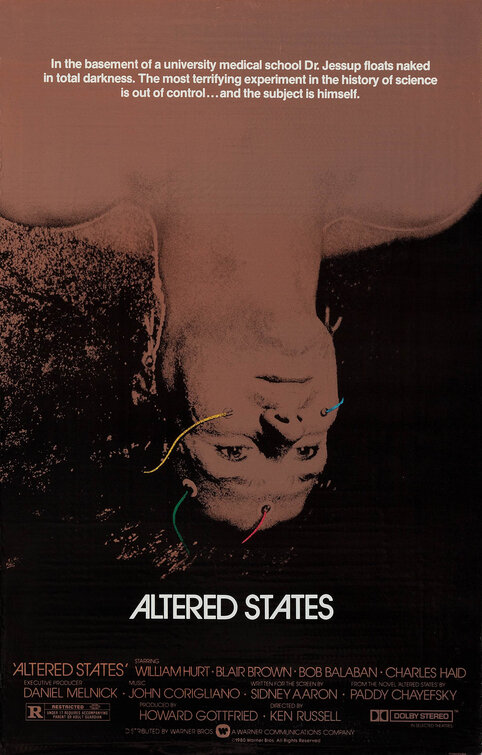
One of my coworkers at one of my many jobs asked me for advice about sensory deprivation tanks--did I know of any? Apparently the only one this person had found is in at Full Circle Yoga Institute in San Diego. My coworker knows I practice yoga, and that's why this person asked me--if one yoga center has a sensory deprivation tank, why not another? I had trouble focusing on the question, because the moment this person said "sensory deprivation," I thought of a scene in "Altered States" where the main character Edward Jessup has regressed so far back into collective consciousness that he's become a kind of Neanderthal who goes on a killing rampage at the zoo. Later he says something like this to his wife: "Last night I hunted, killed, and ate a goat. It was one of the most sublime experiences of my life."
Thursday, July 12, 2007
Faster Pussycat
Riding the bus is close to drifting in a place where it's difficult to drift on foot. Many literal drifters are on the bus, or else they're fading into the landscape--hiding out in the grass by lagoons or sleeping in the same groves that the egrets nest in. The train, which used to be fast, now feels slow--the train whistle gives the day a rhythm that seems less frenetic than, say, the highway. But of course, the highway is often slow. In last Sunday's travel section in the San Diego tribune, there was an article about how riding the train to LA is faster than driving. This is true.

Mark and I watched Russ Meyer's Faster Pussycat, Kill! Kill! (1965)last night. Until I moved out here I'm not sure the scenes of drag racing in the desert and the horror of the train would have made any sense to me. The male characters are pretty violent, but they can't imagine that female desire for domination could be physically violent. Kirk, the older brother, is especially dense, even though his older brother, "The Vegetable," is the one who supposedly isn't right in the head. It's hard to feel triumphant about Kirk and Linda getting away together in the pickup truck.

Mark and I watched Russ Meyer's Faster Pussycat, Kill! Kill! (1965)last night. Until I moved out here I'm not sure the scenes of drag racing in the desert and the horror of the train would have made any sense to me. The male characters are pretty violent, but they can't imagine that female desire for domination could be physically violent. Kirk, the older brother, is especially dense, even though his older brother, "The Vegetable," is the one who supposedly isn't right in the head. It's hard to feel triumphant about Kirk and Linda getting away together in the pickup truck.
Subscribe to:
Posts (Atom)


